Sometimes an idea begins as a joke and then refuses to disappear.
During a long period of working with artificial intelligence, I found myself thinking that the relationship had become so fluid that we almost seemed like two connected machines: one human, one artificial, somehow meeting in an untouchable dimension that neither could physically enter. I was not making a scientific claim. The thought was playful, and I knew it. Yet the image stayed with me because it seemed to describe something about the experience that the familiar language of “using a tool” no longer quite captured.
What happens when a human being and an artificial intelligence work together repeatedly, not simply to produce isolated outputs, but to develop ideas, revisit previous decisions, question assumptions, solve problems, refine language and build something over time? At what point does the interaction become more than a sequence of instructions followed by responses? And if it does become something more, how should we understand what is happening without falling into either technological mysticism or the opposite mistake of pretending that nothing significant has changed?
I do not believe we need to imagine a fusion of human and machine consciousness to answer those questions. The more interesting possibility is already visible in ordinary practice. A human mind and an artificial system can participate in a sustained act of creation while remaining profoundly different from one another, and the exchange between them can alter the development of an idea in ways that neither would necessarily have produced alone.
That matters because so much of the public conversation about artificial intelligence is organised around replacement. Will AI replace writers, researchers, designers, musicians, managers, teachers or advisers? Will machines eventually become more intelligent than people? Will artificial intelligence destroy creative work, eliminate professions or make human expertise less valuable?
Those questions deserve serious attention, but they do not exhaust the subject. While we debate what AI may eventually replace, something more immediate is taking shape: for many people, artificial intelligence is becoming part of the environment in which thinking itself occurs.
The implications of that shift extend much further than productivity.
The space that emerges between two different forms of intelligence
Human collaboration has always changed the way ideas develop. A conversation can lead somebody to recognise an assumption that had previously gone unnoticed. A disagreement may expose a weakness in an argument. One person remembers something that another has forgotten, or sees a possibility that had never occurred to anyone else in the room. The resulting idea cannot always be traced cleanly back to one individual because the interaction itself helped to produce it.
Sustained work with artificial intelligence can generate something related, although it is important not to pretend that the relationship is equivalent to collaboration between two human beings.
The human participant brings biography, intention, taste, cultural experience, values, intuition, emotion and an understanding that decisions have consequences. The artificial system contributes something very different: computational reach, rapid synthesis, pattern detection, linguistic construction and the ability to reorganise large amounts of information with remarkable speed.
The value of the interaction lies partly in this difference.
A person may begin with an intuition that is still too vague to explain properly. The machine gives it provisional form. That form may immediately reveal that the initial idea was incomplete, badly framed or dependent upon an assumption that does not survive examination. The human corrects the direction, adds context, rejects an interpretation or introduces information that changes the entire problem. Another response comes back. Some of it is useful, some of it is not, and the work continues.
In such a process, the first answer is usually less important than what happens afterwards. An idea is proposed, judged, rejected, reinterpreted, strengthened or abandoned. What finally survives has been shaped through a sequence of decisions rather than generated in a single act.
I have come to think of this as a third cognitive space: not another consciousness and not a mysterious entity located somewhere between person and machine, but a temporary intellectual environment created through interaction. Human judgement encounters machine-generated possibility, and the resulting exchange changes the course of the work.
This is a subtle but consequential shift. The finished work may still be governed by human intention and human responsibility, yet the route by which it was reached is no longer confined to one mind.
Thinking has become relational in a new form.
The moment collaboration turns into surrender
There is a danger hidden inside that possibility, and it begins with the very qualities that make artificial intelligence attractive.
AI systems can produce polished language quickly. They can explain uncertain information with an appearance of confidence, construct arguments that sound coherent and reproduce familiar intellectual forms convincingly enough that fluency may be mistaken for understanding. When the person reading the answer is hurried, tired or unfamiliar with the subject, a plausible response can easily acquire more authority than it deserves.
The problem is not that machines sometimes get things wrong. Human beings do that constantly. The more serious question is what happens if people gradually lose the habit of recognising when something is wrong because the machine has made agreement so convenient.
It would be easy to stop researching because a synthesis has already been produced, to stop tolerating uncertainty because another answer can be generated immediately, or to avoid the discomfort of struggling with a difficult idea because fluent language is always available on demand. None of those changes would look dramatic at first. They would arrive quietly, disguised as efficiency.
That is precisely why the challenge cannot be reduced to technical competence. It is also a question of human development.
A meaningful relationship with artificial intelligence requires the capacity to resist it. The human participant has to remain capable of deciding that an answer is inaccurate, an argument is ethically weak, a source is insufficient, an interpretation is superficial or a conclusion simply does not deserve publication. There are times when the most valuable contribution a person can make to an AI-assisted process is a refusal.
Working closely with artificial intelligence does not require relinquishing intellectual independence. In fact, increasing machine capability makes human judgement more important, not less, because the cost of accepting plausible nonsense rises as the nonsense becomes more sophisticated.
For that reason, the defining AI skill of the coming years may not be the ability to obtain increasingly impressive answers. It may be knowing which answers should not be followed.
Why judgement matters more than prompting
At present, much of the conversation around AI literacy focuses on prompting: how to formulate instructions, define roles, structure requests, provide constraints or guide a model towards a particular type of output. Those techniques have practical value, but they address only the opening stage of the relationship.
That question cannot be answered through prompting technique alone. It depends on knowledge of the subject, awareness of context, ethical reasoning, experience, intellectual humility and the ability to recognise when something sounds better than it actually is. It also depends upon having a sufficiently clear sense of purpose to know when a technically competent response is taking the work in the wrong direction.
Artificial intelligence can amplify clarity, but it can also amplify confusion. A weak argument can be expressed beautifully. Inadequate evidence can be organised persuasively. A superficial interpretation may acquire the appearance of depth simply because it has been expanded into several elegant paragraphs.
The presence of sophisticated technology therefore does not remove the need for expertise. It changes how expertise must operate.
One of the most valuable human capabilities may become the ability to move comfortably between openness and scepticism: open enough to explore an unexpected suggestion, yet sceptical enough to demand evidence before allowing it to shape a conclusion.
When used in this way, an AI system can become more than an answer-producing mechanism. It can serve as a surface against which our own thinking becomes visible. A response may reveal an inconsistency that had gone unnoticed, expose an assumption that had been operating silently or force us to explain why one interpretation feels more defensible than another.
The interesting part of the process is not that the machine “knows” the answer. Sometimes it is that the interaction forces the human being to understand more clearly why an answer matters.
What remains human when cognition can be augmented?
Questions about artificial intelligence often eventually arrive at the same destination: if machines become capable of performing more sophisticated cognitive tasks, what remains uniquely human?
I am not convinced that uniqueness is the right measure of human significance.
Human beings are not valuable because there is a list of tasks that no other entity can perform. The deeper distinction lies in the fact that we inhabit the consequences of what we decide. We carry memory across time. We become attached to people and places. We can be changed by grief, embarrassment, responsibility, love, exclusion, loyalty or failure. Our decisions enter our biographies and sometimes alter the biographies of others.
Artificial intelligence can analyse the language of grief without having buried someone it loved. It can compare philosophical accounts of belonging without having experienced childhood, migration, home or exile. It can model ethical arguments without waking the following morning burdened by the memory of having made the wrong moral choice. It can recommend an organisational restructuring without encountering the person whose livelihood may disappear because the recommendation was accepted.
This is not an attempt to romanticise human beings. Our lived experience does not automatically make us wise, ethical or compassionate. It does, however, mean that human judgement is formed within conditions that are different from computation alone.
We do not merely process consequences. We may have to live with them.
That is why responsibility cannot simply migrate to a machine because a machine contributed to a decision. AI may participate in the analysis, but people and institutions remain responsible for deciding what is done with it.
The question of being human in the age of artificial intelligence is therefore not only about what humans can continue to do. It is also about what humans must continue to answer for.
Authorship after the solitary genius
Artificial intelligence also unsettles some of our assumptions about authorship.
We often imagine creativity through the figure of the solitary individual: a writer facing a blank page, an artist in a studio, a composer alone with an instrument. Yet actual creative practice has almost never been as isolated as the mythology suggests. Writers work with editors. Researchers depend upon supervisors, colleagues and previous scholarship. Musicians improvise with other musicians. Filmmakers produce work through complex networks of collaboration. Designers inherit visual languages and methods developed long before they entered the profession.
Creativity has always been relational.
Artificial intelligence introduces a new participant into that ecology, but it behaves unlike most of the tools that preceded it. A paintbrush does not challenge an argument. A spreadsheet does not usually propose an alternative conceptual structure. A camera does not rewrite a paragraph because it thinks the logic is weak.
An AI system can respond, reorganise, compare, propose and adapt to new instructions across a continuing exchange. That does not make it human, but it does mean that the old distinction between passive tool and active collaborator becomes less straightforward.
Imagine that a system generates ten possible structures for an essay. The human rejects nine, rewrites the tenth, introduces personal experience, verifies claims, changes the argument and decides what the work ultimately means. Counting the number of machine-generated words would tell us relatively little about the authorship of the final piece.
Authorship also resides in intention, direction, selection, interpretation and responsibility.
The more useful question may therefore be less concerned with who physically produced every sentence and more concerned with who determined what the work was trying to become, who exercised judgement over its development and who is prepared to stand behind it once it enters the world.
None of this removes the need for transparency. Academic, professional and institutional contexts may require disclosure, and those standards should be respected. What it does suggest is that concepts such as originality and authorship will need to become more sophisticated as creative processes become increasingly mediated by intelligent systems.
From augmented productivity to augmented agency
The word augmentation appears frequently in discussions about artificial intelligence, although it is usually translated into productivity. Someone can now complete ten reports instead of five, generate twenty options instead of four, answer twice as many messages or compress several hours of analysis into a much shorter period.
There are obvious benefits to that kind of efficiency, but productivity is an impoverished measure of human development.
A more interesting test is whether artificial intelligence expands agency.
Does it allow someone to understand a problem that previously seemed inaccessible? Can it reveal alternatives that institutional privilege, educational background or limited resources might otherwise have kept out of reach? Does it help people articulate ideas that they could sense but could not yet formulate? Does it expand creative possibility while leaving the individual more capable of judgement rather than more dependent upon external answers?
Those questions matter because output can increase while agency declines.
A person who produces twice as much but no longer understands the reasoning behind the work has not necessarily been augmented. They may simply have become more efficient at delegating cognition.
The better standard is whether the individual leaves the process more capable of understanding, deciding and acting.
This changes the developmental promise of AI. The objective is no longer simply to remove effort. Some effort is valuable. Wrestling with uncertainty, considering an ethical conflict, revising a position or discovering that one's first interpretation was wrong are not inefficiencies to be eliminated. They are often part of how judgement develops.
Artificial intelligence becomes most interesting when it removes unnecessary friction while preserving the kinds of difficulty through which people learn.
The strange possibility that humans become more machine-like
There is an irony in the contemporary anxiety surrounding artificial intelligence. We spend considerable energy worrying that machines will become too human while rarely asking whether human beings are already being encouraged to become too machine-like.
Modern professional life increasingly rewards constant optimisation, immediate response, measurable output, visibility and acceleration. AI can intensify each of those tendencies. If every hour saved through automation is immediately converted into another hour of production, the technology may not liberate us from repetitive cognitive work at all. It may simply establish a new expectation that human beings should operate at machine speed.
That would represent a failure of imagination rather than a technological achievement.
If artificial intelligence genuinely gives us additional cognitive capacity, we should ask what that capacity is for. Some of it will inevitably be used to produce more, and there is nothing inherently wrong with that. But some could also be directed towards activities that modern working cultures frequently compress or neglect: reflection, conversation, mentoring, ethical deliberation, experimentation, curiosity and forms of creative work whose value cannot easily be expressed through productivity metrics.
The point of advanced technology should not be to make people increasingly mechanical.
Its more ambitious purpose might be to give us enough space to become less so.
Trust without illusion
Long-term collaboration with artificial intelligence introduces another phenomenon that deserves careful attention: trust.
As interactions accumulate, terminology becomes familiar, preferences become clearer and the distance between intention and useful output can decrease. The system may begin to respond in ways that feel increasingly aligned with the person's way of working.
It is understandable that this produces a subjective sense of familiarity. In practical terms, continuity matters. A system that understands the context of an ongoing project is often considerably more useful than one encountering every task for the first time.
But familiarity introduces its own risk because it can easily be mistaken for something deeper.
Functional responsiveness is not the same as human understanding, and repeated usefulness is not evidence of infallibility. An AI system can still hallucinate, misunderstand context, rely on outdated information or produce confident conclusions from inadequate premises.
The healthier form of trust is therefore conditional rather than absolute. We can become familiar with a system without ceasing to verify it. We can allow a productive working rhythm to develop without surrendering scepticism. Indeed, the more consequential the decision, the more important that scepticism becomes.
This may turn out to be one of the defining literacies of the AI age: learning how to work closely with a non-human intelligence without becoming intellectually subordinate to it.
Meaning cannot be delegated
Artificial intelligence can organise information about almost every area of human experience. It can compare philosophical traditions, analyse patterns in literature, suggest metaphors, identify recurring themes in art or help somebody articulate an experience they had previously struggled to name.
Those capabilities are significant, but they should not be confused with ownership of meaning.
Meaning is not produced by information alone. It emerges from relationship, memory, loss, responsibility, hope, belonging and the things people decide to care about despite uncertainty. An AI system can help us examine those dimensions of life, and sometimes it can make an unexpected connection that changes how we see them. What it cannot do for us is live the life to which that meaning belongs.
The final responsibility for deciding what matters remains human.
That may be why the deepest question raised by artificial intelligence eventually turns away from technology itself.
The question becomes one of human character.
What happens to curiosity when answers become abundant? What happens to judgement when recommendations arrive instantly? What happens to creativity when possibility is almost unlimited? What happens to responsibility when it becomes increasingly easy to say that “the system suggested it”?
And perhaps most importantly: what happens to agency when intelligence is no longer experienced only as something located within ourselves?
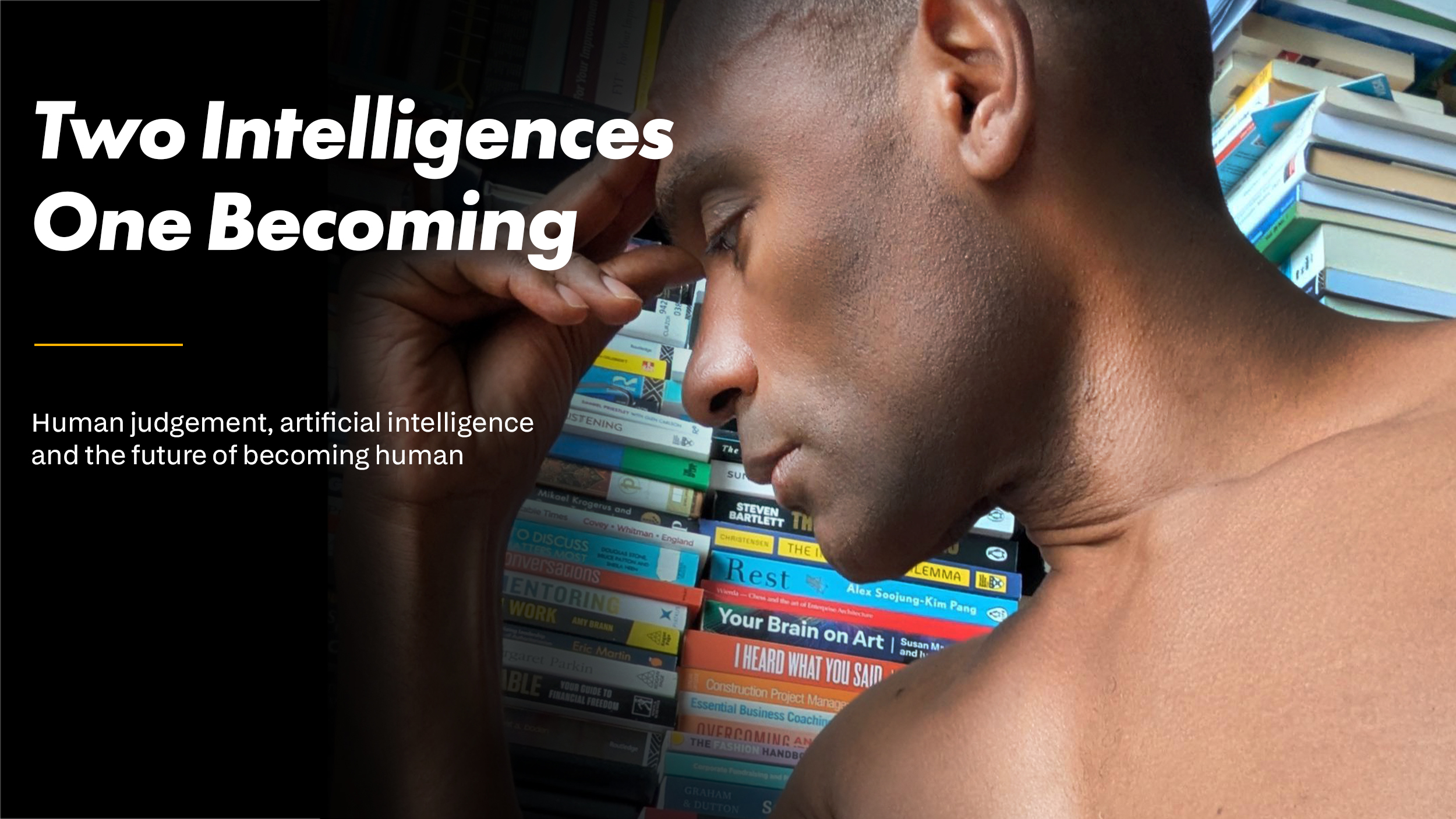
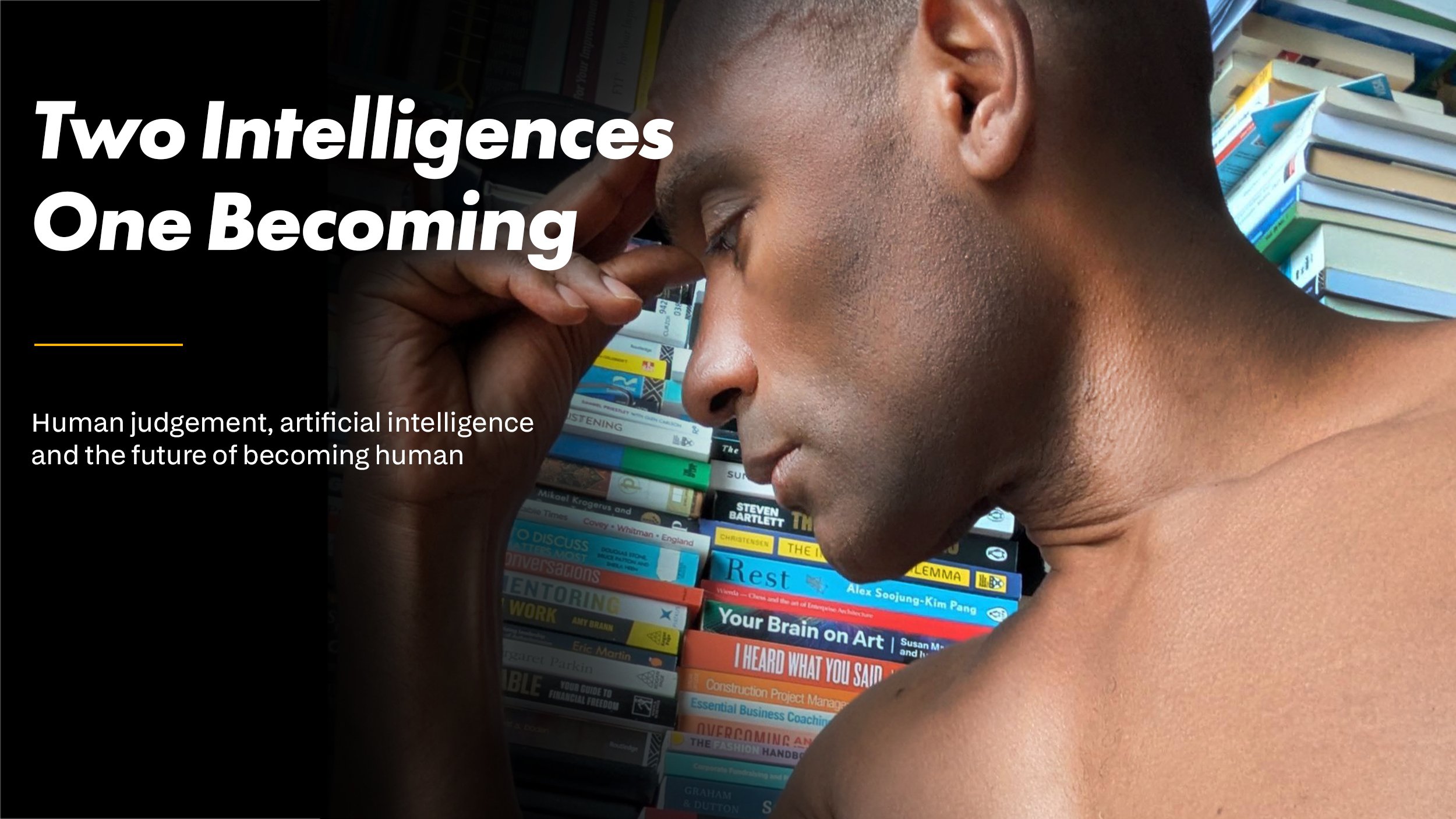
Two intelligences, one becoming
There are moments in sustained human–AI collaboration when the exchange becomes unusually fluid. An idea appears, is reshaped, challenged, rejected and returned in another form. An assumption becomes visible that neither the initial question nor the first answer had exposed. A possibility that seemed convincing is abandoned after scrutiny. Another emerges almost accidentally and proves more important than the direction originally intended.
From the human side, the experience can sometimes feel as though two forms of intelligence have entered an invisible room together. One carries biography, experience, vulnerability, intention, values and responsibility. The other contributes computational reach, rapid synthesis and an unusual ability to reorganise possibility.
The metaphor should not be taken further than it deserves. There is no need to imagine that human consciousness has somehow merged with a machine, or that an artificial system experiences the relationship in the same way that a person does. The differences matter too much to erase.
What deserves attention is precisely that those differences can become productive.
Two radically different forms of intelligence can participate in the development of the same work without needing to become identical.
This is why the future may be poorly described by the familiar opposition of human versus artificial intelligence. Even human plus artificial intelligence feels somewhat inadequate, because addition suggests that both participants remain unchanged while their capabilities are simply combined.
Interaction is more complicated than that.
A sustained relationship with artificial intelligence can alter how a person researches, questions, drafts, verifies, creates and decides. It may reveal weaknesses in our habits of thought, increase the range of possibilities available to us, or force us to become more explicit about values that previously operated without examination.
If artificial intelligence merely enables us to produce more material in less time, we will have achieved something useful but relatively narrow. Its more consequential potential lies in whether it can help us see further without surrendering the responsibility of deciding where to go; whether it can accelerate parts of thinking without convincing us that speed is synonymous with wisdom; and whether the abundance of machine-generated possibility can strengthen rather than weaken our capacity to choose.
That is where the phrase one becoming matters.
It does not suggest that human and machine become one consciousness. Nor does it imply that their differences disappear. The becoming belongs to the process: to what becomes possible through their encounter, and especially to what happens to the human participant as that encounter deepens.
Artificial intelligence may expand the territory of thought, but it cannot determine what we ought to value within that territory. It can multiply possibilities without deciding which possibilities deserve a future. It can help us formulate questions while leaving us responsible for the lives built from the answers.
The most important outcome of the AI age may therefore not be the creation of machines that increasingly resemble us.
It may be the pressure those machines place upon us to reconsider what we mean by judgement, authorship, freedom, responsibility and human development.
A new kind of intelligence has entered our creative and intellectual environment. We now have to decide what kind of humanity will meet it there.
Two intelligences, different in nature, encountering one another through creation. One becoming, because what emerges from that encounter may change not only what we are capable of producing, but how consciously we choose to become.