The Dangerous Game: Visual Provenance in the AI Age

What a striking visual similarity reveals about authorship, attribution and responsibility.
Explore Carlos Simpson’s research, publications, creative practice and human-development work.
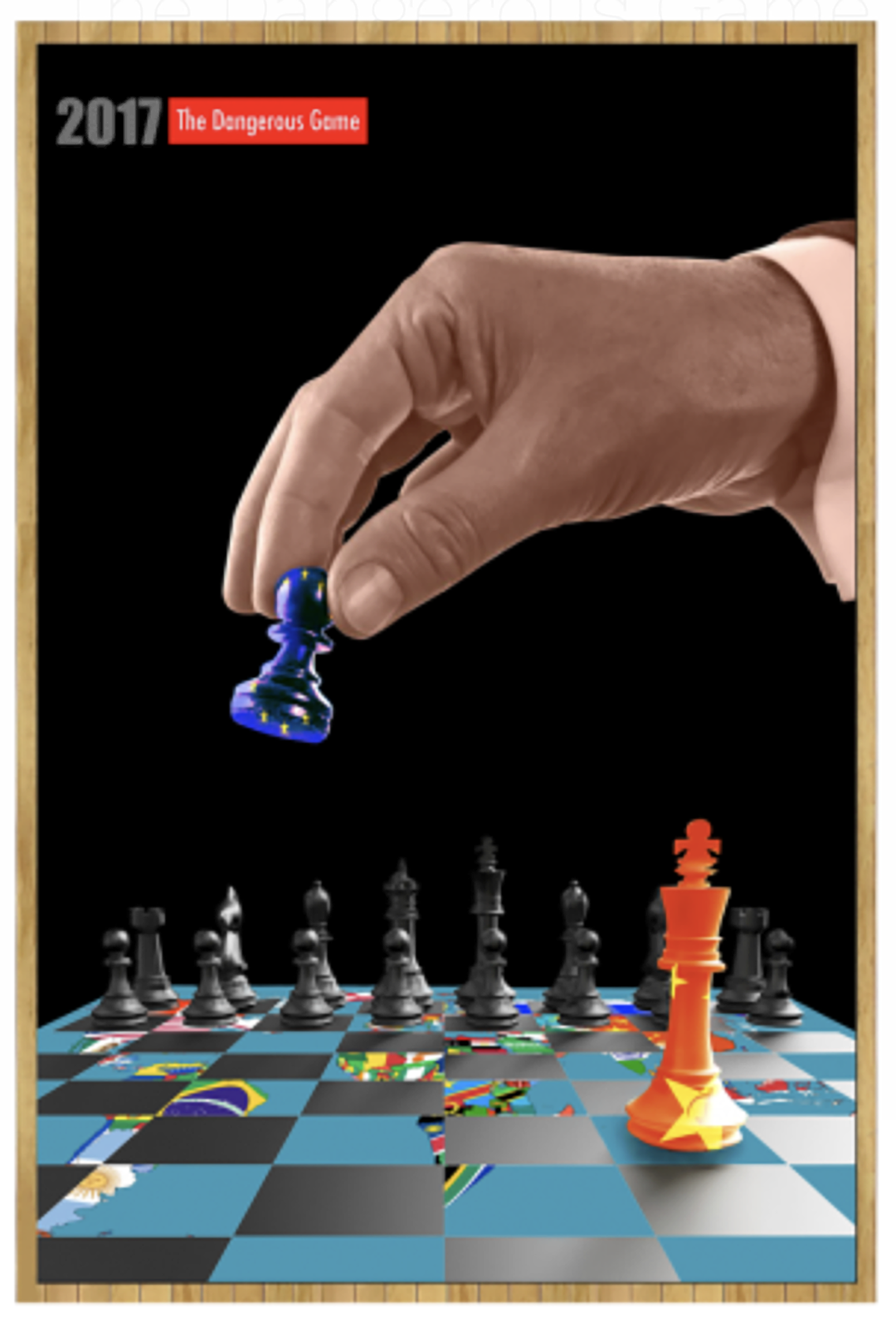
In 2017, I created The Dangerous Game, a self-directed conceptual artwork examining political power, strategic control and the positioning of people and nations within systems shaped by forces larger than themselves.
The composition presents an oversized hand entering from above and holding a blue chess piece over a board constructed from national flags. Dark pieces occupy the central field, while a prominent orange figure stands apart in the foreground. The chessboard establishes a system of rules and territorial divisions. The hand introduces an external authority capable of intervening in that system. The differently coloured pieces raise questions about visibility, hierarchy, resistance and agency.
The work was not intended as an illustration of one political event. It was concerned with a more enduring question: when human beings, institutions and nations appear to be making independent moves, who or what may be shaping the conditions in which those moves become possible?
I published the artwork on LinkedIn in 2017, creating a publicly dated record of its existence and authorship.
View the original 2017 LinkedIn publication
Encountering a familiar visual structure
In August 2026, I encountered the article Designing for the Proxy, published through UX Collective. The accompanying illustration presents designers as figures positioned on a chessboard beneath an oversized hand.
View the article and accompanying illustration
The newer illustration is not identical to The Dangerous Game. Its format, colour palette, characters and immediate subject are different. It places several human figures on a chessboard and connects the metaphor to contemporary design practice and artificial intelligence.
The resemblance nevertheless deserves attention.
Both images use an oversized hand descending from above. Both place human or human-like figures within the structure of a chessboard. Both distinguish one figure through a strong orange accent while surrounding figures remain comparatively dark. Both construct a visual relationship between external control, strategic movement and the treatment of people as pieces within a larger system.
Chess has been used as a metaphor for power, conflict and strategic control throughout visual culture. No artist can claim ownership of the chessboard as an idea. Nor can visual similarity, by itself, establish how another work was created.
The question arises from the particular combination of elements, their compositional relationship and the closeness of the underlying visual proposition.
A question of provenance, not an accusation
I do not know how the newer illustration was developed. I do not know who produced it, what references were consulted or whether a generative-image system formed part of the process.
For that reason, I have not presented the resemblance as proof of copying. I have asked the author publicly for clarification about the illustration’s creator, its development and whether generative tools or visual references were used.
That distinction matters.
A responsible enquiry begins with what can be observed and separates it from what remains unknown. The observable fact is that an illustration published in 2026 contains a notable cluster of similarities to an artwork I created and published in 2017. What cannot yet be established is the route through which those similarities emerged.
The purpose of documenting the encounter is therefore not to declare an offence. It is to preserve the chronology of my work and to ask a wider question about creative provenance.
What changes when machines participate in image-making?
Visual culture has always developed through reference, influence, quotation, reinterpretation and shared conventions. Artists and designers learn by encountering earlier work. Ideas move between disciplines and generations. Similar solutions can also arise independently when different creators respond to comparable subjects.
Generative systems complicate this history because their influences are rarely visible at the point of production.
A person using such a system may enter a written instruction without knowing which images, visual structures or compositional patterns contributed to the result. The system can produce something that appears new while retaining relationships to existing work that neither the user nor the audience can readily identify.
This does not mean that every resemblance is evidence of generative AI. It means that provenance has become harder to establish at precisely the moment when producing and distributing images has become easier.
The question is no longer confined to whether an image has been copied directly. We must also ask how visual memory travels through computational systems, how creators can recognise inherited structures and what obligations publishers have when the origin of an illustration is unclear.
The archive is part of the work
For artists and designers, maintaining an archive is no longer an administrative task separated from creative practice. It is part of protecting the continuity of the work.
Original files, sketches, contact sheets, drafts, metadata, publication records and dated social-media posts can establish when a concept entered public view and how it developed. None of these materials can answer every question of influence, but together they create a credible record of authorship and chronology.
My 2017 LinkedIn publication is important for this reason. It does not merely promote The Dangerous Game. It records that the work existed publicly nine years before the newer illustration appeared.
The original Photoshop file, exported images and associated documentation provide further evidence of its development. This documentation allows the discussion to begin from verifiable dates rather than recollection alone.
Creative work needs this form of continuity, particularly when images can be detached from their origin, reproduced rapidly and encountered without context.
A higher standard for creative transparency
Artists, designers, writers, publishers and technology platforms now share a responsibility to make image provenance more intelligible.
Where an illustration has been commissioned, the illustrator should be credited. Where stock material or earlier work has informed the image, that relationship should be acknowledged where appropriate. Where generative AI has played a material role, the process should not be concealed behind ambiguous language such as “digital artwork” or “creative production”.
Transparency does not diminish the work. It allows the audience to understand what kind of work it is.
Publishers also need clearer procedures for recording who produced an image, what tools were used and what rights accompany its publication. At present, written authorship is often visible while the origin of a prominent accompanying illustration remains uncertain.
That imbalance is no longer adequate. Images do not simply decorate ideas. They shape interpretation, carry cultural memory and contribute intellectual meaning of their own.
Who directs the next move?
When I created The Dangerous Game, the oversized hand represented a force capable of entering the visible system and moving its pieces. The work asked who possesses agency, who defines the rules and whose interests remain concealed behind strategic decisions.
Nine years later, encountering a visually related composition has given that question another dimension.
Who directs the movement of an image through culture? Who can identify the sources embedded within it? Who is responsible when a system produces a result that resembles earlier work?
What should an author, designer or publisher disclose when the creative process includes tools whose visual memory cannot be inspected easily?
These questions cannot be resolved through accusation alone. They require evidence, dialogue and a more serious culture of attribution.
I have asked for clarification and will update this article if further information becomes available.
The Dangerous Game remains what it was when I created it in 2017: an examination of power, strategic control and human agency. Its renewed relevance lies in the fact that the board has changed, while the question of who moves the pieces has become more difficult to answer.
Artwork details
Title: The Dangerous Game
Artist: Carlos Simpson
Year: 2017
Discipline: Conceptual art and strategic graphic design
Themes: Political power, strategic control, geopolitics, hierarchy, visual symbolism and human agency
Copyright: © 2017 Carlos Simpson. All rights reserved. No unauthorised reproduction, alteration, redistribution, commercial use, dataset inclusion, machine-learning use or AI training use without prior written permission.