Love
Connection, compassion and love as a sustaining human force.
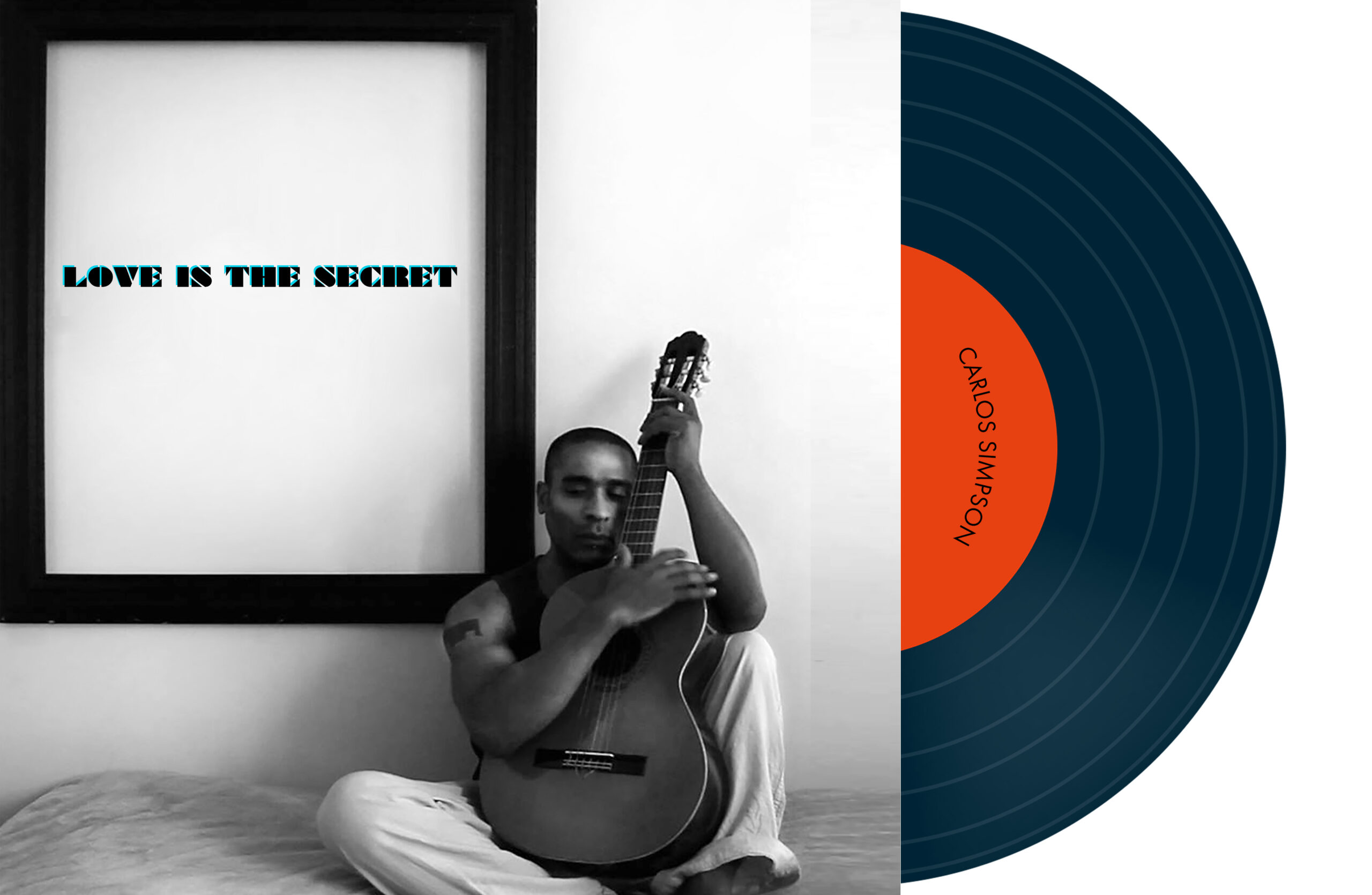
Love Is The Secret — official album artwork · Carlos Simpson · 2020
Explore Carlos Simpson’s research, publications, creative practice and human-development work.
Carlos Simpson
Love Is The Secret is the second studio album by Carlos Simpson, released on 29 November 2020 as part of My 2020 Lockdown Project. Entirely improvised, the album documents an extraordinary historical moment through songs about love, freedom, identity, memory, vulnerability, control and human connection.
About Love Is The Secret
Love Is The Secret emerged from Carlos Simpson’s self-directed My 2020 Lockdown Project, a wider body of music and writing created during the COVID-19 lockdown.
The album was entirely improvised and functions as both a personal record and a document of a particular historical moment. Its songs move through uncertainty, emotional isolation, relationships, memory, freedom and the desire to remain connected when ordinary life had been dramatically disrupted.
Rather than treating love exclusively as romantic experience, the album repeatedly approaches it as a wider human force: something connected to compassion, freedom, friendship, self-knowledge and the ability to continue through difficulty.
Meaning & artistic background
The album repeatedly moves between emotional connection and personal isolation.
Blind examines belief when the surrounding world appears to be falling apart. Blame considers responsibility and the avoidance of self-reflection. Promises and Surreal Dreams and Delusional Perception explore the tension between idealised possibility and lived reality.
The title track positions love as an organising principle, while Real Friend, Mother and My Butterfly connect love to friendship, acceptance, individuality and freedom.
The closing movement becomes increasingly introspective. Imaginary Friend turns towards idealisation and escapism, while Losing Control confronts vulnerability, waiting and the passage of time.
Connection, compassion and love as a sustaining human force.
Autonomy, human rights and the desire to live without unnecessary constraint.
The tension between internal narratives, idealised dreams and external reality.
Impermanence, memory, loss and the emotional consequences of change.
Tracklist · meanings · credits
Open each track to explore its meaning, context and recording information.
Faith, collapse and belief when certainty disappears.
Meaning & background
Blind explores the persistence of faith when the structures around an individual appear to be collapsing.
Love, dreams and beliefs are presented as vulnerable to loss, yet something remains: the possibility of continuing to trust even without visible certainty.
The title therefore reflects a form of belief that does not depend entirely upon proof. The song places despair and hope beside one another, creating a tension between what is falling away and what the individual still chooses to hold onto.
Emotional stability, reassurance and the fragile language of being “alright”.
Meaning & background
Lithium explores emotional regulation through repeated affirmations of stability.
Statements that everything is alright gradually acquire an ambiguous quality. They can be understood as reassurance, but their repetition also suggests the effort required to maintain that reassurance.
The title introduces an association with mood stabilisation, while imagery of angels adds a protective or spiritual dimension.
The song therefore sits between genuine equilibrium and the human need to keep telling oneself that equilibrium has been reached.
Responsibility, ego and the cycle of assigning fault.
Meaning & background
Blame examines the tendency to place responsibility elsewhere instead of confronting one's own role in difficult situations.
Its repetition mirrors the circular nature of blame itself: fault moves from person to person without producing meaningful resolution.
The song ultimately questions whether assigning blame protects the ego at the expense of growth and self-awareness.
Time, regret and the search for guidance within uncertainty.
Meaning & background
Oh Lord is a reflection on change, regret and the speed with which life moves.
The repeated invocation of “Oh Lord” functions as a plea for orientation when past decisions, present confusion and the passage of time become difficult to reconcile.
The song places individual regret beside wider cycles of human behaviour — conflict, violence and love — creating a broader meditation on the human condition.
Idealism, disappointment and the distance between dreams and reality.
Meaning & background
Promises and Surreal Dreams explores the contrast between idealised possibility and lived reality.
Promises imply certainty and future fulfilment, while surreal dreams suggest experiences that are beautiful, unstable or impossible to hold onto.
The track moves through longing, isolation and reflection, questioning what remains when imagined futures fail to become real.
Its emotional centre is the recurring human attempt to create meaning while recognising that life, relationships and desire are temporary.
Dreams, illusion and the unstable relationship between perception and reality.
Meaning & background
Delusional Perception examines the possibility that our understanding of life may be shaped by idealised narratives rather than by reality itself.
Dreams, relationships and imagined futures are contrasted with solitude and impermanence.
The song repeatedly moves between creation and destruction, hope and disappointment, suggesting that people can become trapped inside cycles of expectation.
Freedom begins when those cycles are recognised and the individual returns to a clearer understanding of the self.
Love as connection, guidance and a sustaining force within human life.
Meaning & background
The title track presents love as a fundamental force within human existence.
Its repeated emphasis on love gives the song a mantra-like structure. Love is not presented merely as romantic feeling, but as something to be experienced, given, recognised and carried into moments of difficulty.
The simplicity of the central phrase is deliberate: the song reduces a complex human question to one recurring proposition — that connection and care remain essential to meaningful life.
External chaos, internal conflict and finding refuge in human connection.
Meaning & background
Joker explores the gap between outward appearance and internal experience.
Images of paradise sit beside anger, pain and dissatisfaction, creating a contrast between what life appears to be and what it feels like from inside.
Against that instability, a personal relationship becomes a place of calm and intimacy.
The track therefore places social frustration beside personal connection, suggesting that genuine relationships can create meaning even when the surrounding world feels contradictory.
Friendship, admiration and the fear of losing a meaningful connection.
Meaning & background
Real Friend is a reflection on genuine companionship and the emotional significance of someone whose presence brings light into another person’s life.
Admiration is combined with the fear of separation, making the repeated desire for the other person to stay central to the song’s emotional tension.
The track treats friendship not as something incidental, but as a meaningful source of love, stability and inspiration.
Freedom, dignity and a universal call for human liberation.
Meaning & background
Venezuela is framed as a call for freedom and human dignity.
Repeated appeals to let children run and let people be free extend beyond one location, turning the title into a broader symbol for liberation.
The song imagines freedom as a basic human condition rather than a privilege: the ability to live, move, express oneself and love without unnecessary restriction.
Freedom, identity, nurturing and the search for meaning.
Meaning & background
Mother connects the desire for freedom with the need for nurturing, acceptance and direction.
Repeated calls to let people be themselves express resistance to unnecessary restriction, while the invocation of “Mother” introduces a symbolic source of care and unconditional acceptance.
The song also acknowledges impermanence. Freedom and self-expression are pursued within a life that remains finite and uncertain.
Separation, introspection and the movement from attachment towards acceptance.
Meaning & background
Left You Alone follows the emotional movement from fascination and attachment towards separation and self-recognition.
The person at the centre of the song is initially experienced as extraordinary and almost dreamlike, but the relationship eventually becomes a source of solitude and introspection.
The shift from feeling trapped inside one's own thoughts to feeling free marks the song’s central transformation.
Its ending replaces possession with acceptance, allowing the other person to leave while the narrator returns to the self.
Idealisation, escapism and the comfort of an imagined reality.
Meaning & background
Imaginary Friend explores the human tendency to construct an idealised refuge from difficult reality.
The imagined figure is described through repeated admiration, becoming a symbol of beauty, comfort and perfection.
That perfection contrasts with a world experienced as disappointing or deceptive.
The song therefore considers both the comfort and danger of escapism: imagined worlds can provide emotional protection, but they also reveal the distance between desire and reality.
Individuality, transformation and the freedom to follow one's own path.
Meaning & background
My Butterfly is centred on individuality, transformation and personal freedom.
The butterfly operates as the primary symbol: something capable of change, movement and displaying its own distinct colours.
Repeated calls to let people fly and be themselves connect the song to the album's broader interest in authenticity and liberation.
Following the sun and following one's dreams become metaphors for choosing a personal direction rather than conforming to the expectations of others.
Vulnerability, waiting and the relentless movement of time.
Meaning & background
Losing Control closes the album with a sustained examination of vulnerability and emotional uncertainty.
The repeated declaration of losing control creates a cyclical, almost hypnotic structure that mirrors anxiety itself.
Waiting becomes increasingly significant as the song unfolds. Time continues moving regardless of whether the anticipated person, event or resolution arrives.
References to life fading with time give the song an existential dimension. The loss of control is therefore not only emotional: it reflects the fundamental inability to stop time itself.
Album information