Research & Framework
Explore Carlos Simpson’s research, publications, creative practice and human-development work.
Human Agency in the Age of AI: From Research Lineage to an Integrated Framework
Human agency in the age of AI is not a question that belongs to one paper, one author or one discipline. Across foresight, education, organisational research, public policy, ethics and human development, a growing body of work has examined how artificial intelligence may reshape autonomy, judgement, capability and responsibility.
These different perspectives converge around a fundamental question:
The Research Lineage of Human Agency and AI
The contemporary debate did not begin with generative AI. Earlier research had already begun examining how increasingly automated and technology-mediated systems might affect human autonomy, decision-making and control.
- The Future of Human Agency 2035 — Elon University / Pew Research Center A large expert foresight project examined whether people would retain meaningful control over technology-assisted decision-making and where human authority should remain explicit.
- Artificial Intelligence and Education: Preserving Human Agency in the World of Automation — Emmanuel Dumbuya Dumbuya examined educator autonomy, student agency, critical thinking, creativity and the importance of retaining human judgement in AI-mediated education.
- Human-AI Agency in the Age of Generative AI — Sebastian Krakowski Krakowski explored augmentation, hybrid human-AI agency, organisational decision-making and the changing allocation of cognitive work between people and generative AI.
- Preserving Human Agency in the Age of AI — Vladimír Šucha Published through the European University Institute and the EU Publications Office, this policy work examined skill erosion, resilience, technological dependence and the preservation of human capabilities.
- Human Agency in the Age of AI — John Nosta Nosta approached agency through cognition and learning, asking what happens when AI-generated answers begin replacing active human thinking.
- Reclaiming Human Agency in the Age of Artificial Intelligence — Journal of Moral Theology This work approached the subject through dignity, freedom, moral responsibility, human action and the ethical consequences of increasingly powerful artificial intelligence.
- Human Agency in AI-Augmented Work — Jonathan H. Westover Westover addressed meaningful human control, professional identity, judgement, capability development and the danger of formal human oversight becoming practically meaningless.
Different Works, One Emerging Intellectual Problem
These publications do not constitute a single theory or framework. Their disciplinary starting points differ, and their models are not interchangeable. Yet together they reveal an increasingly coherent intellectual problem.
As artificial intelligence becomes more capable, the central question is no longer limited to what technology can generate, automate, predict or optimise.
An equally important question is what human beings and organisations must remain capable of doing for themselves: understanding context, questioning recommendations, recognising uncertainty, exercising judgement, making decisions, retaining authority and accepting responsibility for consequences.
Where My Work Enters the Conversation
My work contributes to this developing field from the intersection of human development, identity, organisational decision-making, executive practice and judgement.
At Digital Leaders AI Week 2026, I presented:
Human Agency in the Age of Artificial Intelligence: Why Identity, Judgement and Decision Capability Matter More Than Ever
The literature establishes that human agency is already a significant concern across multiple disciplines.
My contribution is to develop an integrated architecture for examining which human capabilities must remain active when artificial intelligence becomes part of the environment through which people and organisations interpret information, exercise judgement and make decisions.
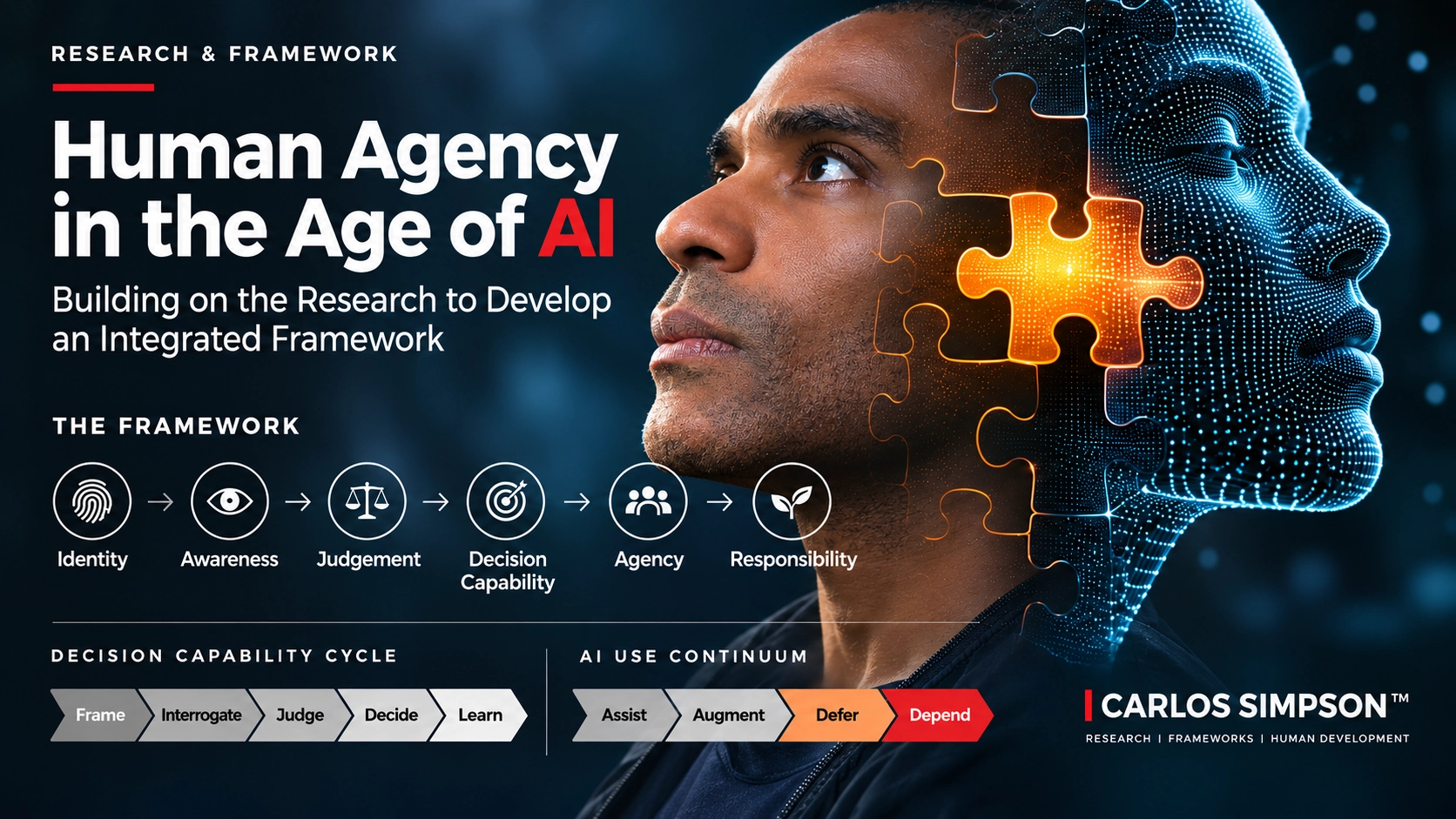
The Human–AI Integration Framework
Six interconnected human capacities
Identity → Awareness → Judgement → Decision Capability → Agency → Responsibility
Identity asks what individuals and organisations must continue to define, value and author for themselves.
Awareness concerns what is being noticed, what is disappearing from view and how technological systems may influence perception and attention.
Judgement concerns the interpretation of evidence, uncertainty, competing values and consequences.
Decision capability concerns whether people can still define problems, evaluate alternatives, challenge outputs and make proportionate decisions.
Agency concerns the capacity to initiate, question, refuse, reinterpret, adapt and act.
Responsibility asks who remains answerable once AI has contributed to a consequential decision.
From Judgement to Decision Capability
If judgement is to remain meaningful, it must be exercised through a process rather than treated as an abstract human quality.
Decision Capability Cycle
Frame → Interrogate → Judge → Decide → Learn
The cycle asks whether people remain capable of defining the real problem, testing evidence and assumptions, interpreting context, deciding with accountability and learning from outcomes.
Artificial intelligence may assist at every stage. Human responsibility remains continuous.
When Assistance Becomes Dependency
The next question is what happens when repeated assistance begins to alter human capability itself.
AI use does not suddenly become dependency at a single identifiable moment. The transition can be gradual.
Human–AI Dependency Diagnostic
Assist → Augment → Defer → Depend
The critical variable is not simply how frequently AI is used. It is whether people retain the ability to understand, challenge, reconstruct and defend the reasoning behind a decision.
What This Framework Adds
The contribution of this work is not to introduce the concept of human agency in relation to artificial intelligence. That concern is already established across the literature reviewed above.
The contribution I am developing lies in connecting identity, awareness, judgement, decision capability, agency and responsibility as an integrated human-development and organisational architecture.
The framework then translates those capacities into practical models for examining AI-supported decision-making, dependency, accountability and organisational capability.
This moves the conversation from the general proposition that humans should remain “in control” towards more operational questions:
- What must people still understand?
- What must they remain capable of questioning?
- Which decisions require meaningful human judgement?
- What capabilities might deteriorate through habitual delegation?
- Who remains responsible when AI contributes to an outcome?
Human Agency as an Organisational Capability
The emerging literature suggests that human agency cannot be separated from autonomy, learning, identity, judgement, capability, control and responsibility.
For organisations, this means responsible AI cannot be achieved merely by inserting a human somewhere into an automated workflow.
A person may technically remain “in the loop” while lacking the time, information, expertise or authority required to challenge the system.
Meaningful human agency therefore requires more than human presence. It requires maintained human capability.
The strategic question is not whether humans or machines should prevail. It is how technological capability, organisational systems and human capability can evolve together without making human judgement optional.
Selected Research and Sources
- The Future of Human Agency 2035 Read the research
- Artificial Intelligence and Education: Preserving Human Agency in the World of Automation Read the paper
- Human-AI Agency in the Age of Generative AI Read the journal article
-
Preserving Human Agency in the Age of AI
View the official EU publication
View on ResearchGate - Human Agency in the Age of AI Read the article
- Reclaiming Human Agency in the Age of Artificial Intelligence Read the publication
- Human Agency in AI-Augmented Work: Building Meaningful Control in the Age of Intelligent Systems Read the article
Human Agency in the Age of Artificial Intelligence — AI Week 2026
My contribution to this developing field was presented at Digital Leaders AI Week 2026 under the title:
Human Agency in the Age of Artificial Intelligence: Why Identity, Judgement and Decision Capability Matter More Than Ever
A Developing Research Agenda
This work sits within a developing research agenda concerned with how human beings remain capable of thinking, judging, choosing, learning and taking responsibility within environments increasingly shaped by artificial intelligence.
The challenge is therefore not limited to improving the capability of artificial intelligence. It also requires sustained attention to the human capacities through which technological outputs are interpreted, challenged and translated into consequential action.
The question is not simply: How capable will artificial intelligence become?
The equally important question is: What must human beings continue to become better at as it does?