Carlos Simpson / Painting
Explore Carlos Simpson’s research, publications, creative practice and human-development work.
Colour, Curvature
and the Painted Grid
Authorship, chronology and the relationship between the body and the painted grid: my works from 2005–2009 alongside selected paintings by Nick Irzyk.
This essay examines how Carlos Simpson’s paintings from 2005–2009 use a painted grid: rows of coloured cells that bend around figures or recede into pictorial space. It compares selected works with Nick Irzyk’s Cathedral and Tools and Ways (2022). The chronology and visual similarities do not, by themselves, establish copying or influence.
The resemblance between these paintings prompted a specific concern: could elements of a visual language I developed in earlier work have been copied? That question deserves a public record of the paintings, their dates and the features that make the comparison worth pursuing.
My two Time Machine paintings date to 2005. Nick Irzyk’s Cathedral and Tools and Ways, considered here, are dated 2022. Across these selected works, multicoloured cells bend into receding spaces, change scale abruptly and carry smaller marks within their boundaries. It is the combination and organisation of those features that calls for close examination.
The figures in my paintings complicate that comparison. Eyes, mouths and hands remain recognisable inside the pattern; grey bodies interrupt fields of colour. Those interruptions determine where the viewer looks and how the space is understood. The discussion that follows examines both the correspondences and the decisions that distinguish the paintings.
The body within the painted grid
In Time machine - In to the Soul, dated 15 May 2005 in my records, two grey figures interrupt a field of concentric coloured cells. Their outstretched arms establish a bodily measure within a space whose scale is otherwise unstable. As the cells contract towards the centre and widen towards the edges, the figures offer recognisable forms against which to read that distortion.
A second rhythm develops within the grid. Many cells contain repeated linear marks, drawing attention from the circulation of colour to the individual divisions that produce it. From a distance, the pattern suggests rotation; close inspection reveals the separate marks and changes of direction beneath that effect.
Time Machine - Becoming Digital, dated 5 September 2005 in my records, brings the grid onto the body itself. Coloured cells follow the face and raised arms, changing direction around the wrists, forearms and head. The pattern makes bodily volume legible while dividing its surface. Across the torso, a grey, foreshortened figure introduces a contrasting register: its muted colour and projecting feet interrupt the patterned anatomy.
The titles suggest transformation and interior life, but the visual tension is more specific. In one painting, the body interrupts the grid; in the other, the grid becomes its surface. Both ask how a figure can remain recognisably human within a system that repeatedly divides it.
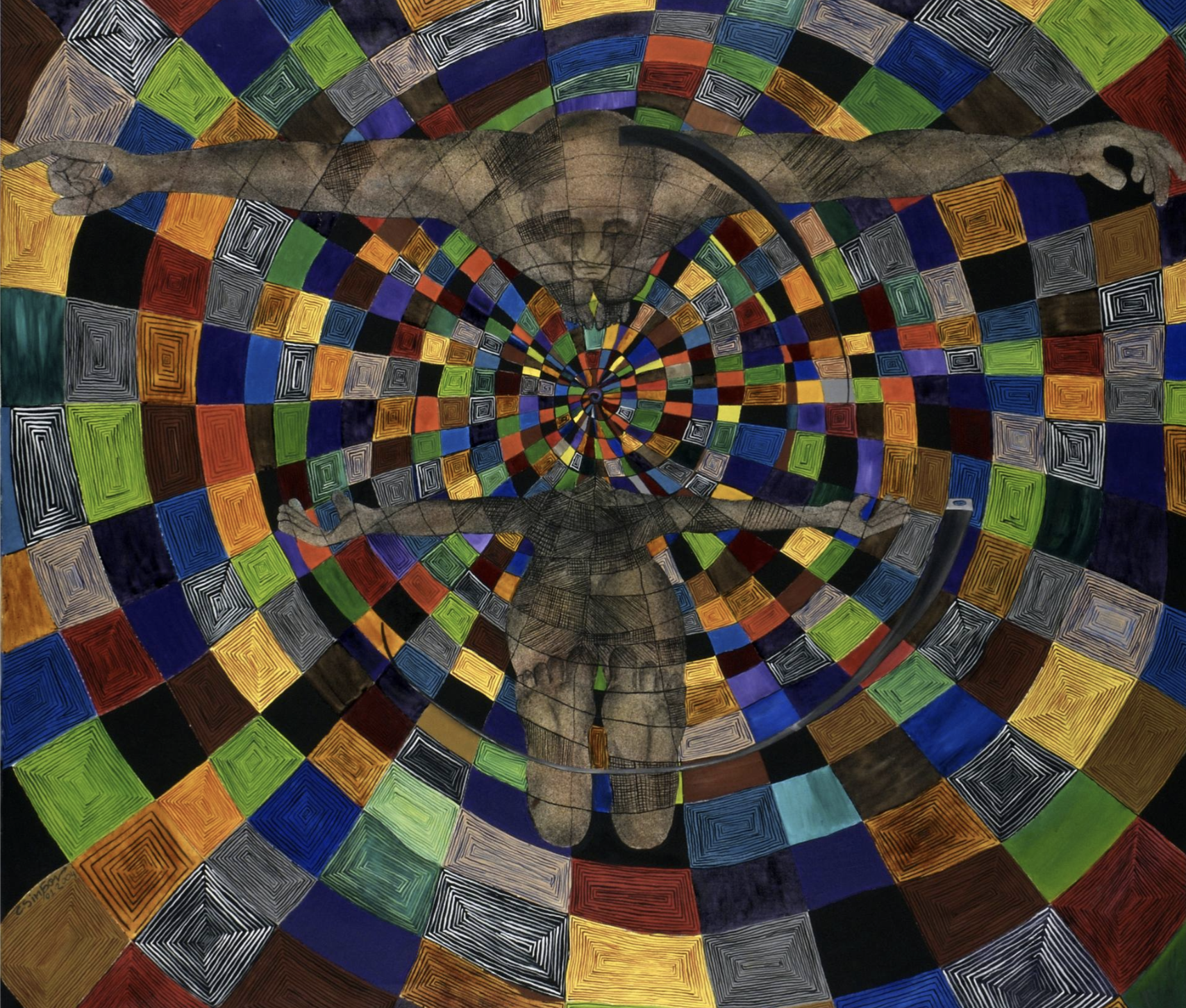
The painted grid and the human figure
In Couple (2009), the incline of one head towards the other establishes a relationship before the viewer has followed a single row of colour. The eyes and red mouths keep the faces distinct. The grid connects them formally, but their unequal positions prevent them from becoming interchangeable.
The detail and the complete painting produce different readings. A crop concentrates attention on the heads. The full composition carries those heads into long vertical streams of colour and places a hand further down the image. That distance matters: the painting moves between concentrated facial expression and a body that seems to extend, dissolve and gather again.
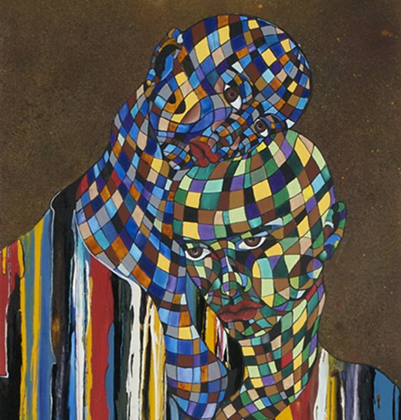
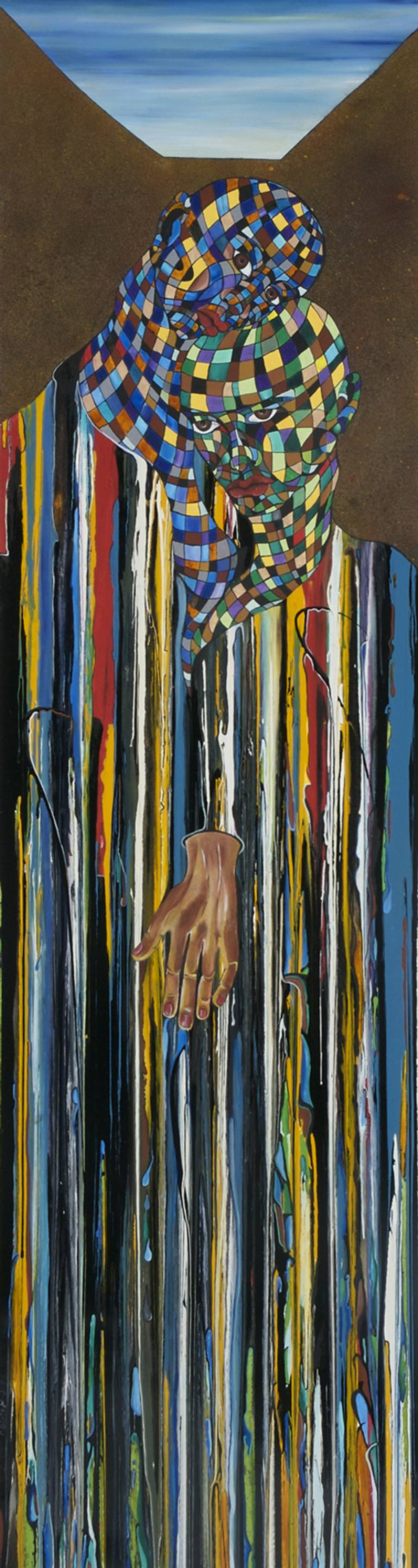
Couple
The tilt of the heads establishes intimacy; the eyes and mouths preserve difference within a shared pattern.
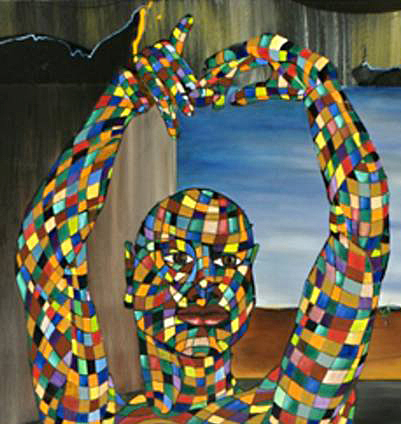
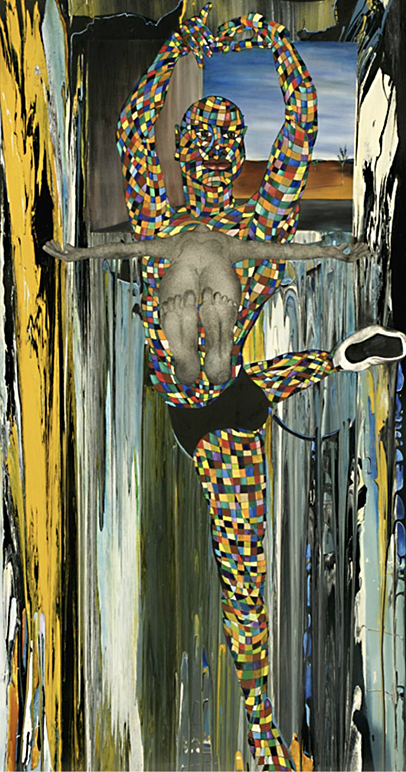
Time Machine - Becoming Digital
Coloured cells change direction across the face, wrists and raised arms, making the grid responsive to anatomy.
The Oedipus Complex (2006) makes recognition less secure. Its eye motif gives the viewer an immediate point of orientation, while the gridded forms around it twist between bodily suggestion and abstraction. A bent passage of colour can register as a limb, then become a shape whose movement matters more than its anatomical identity.
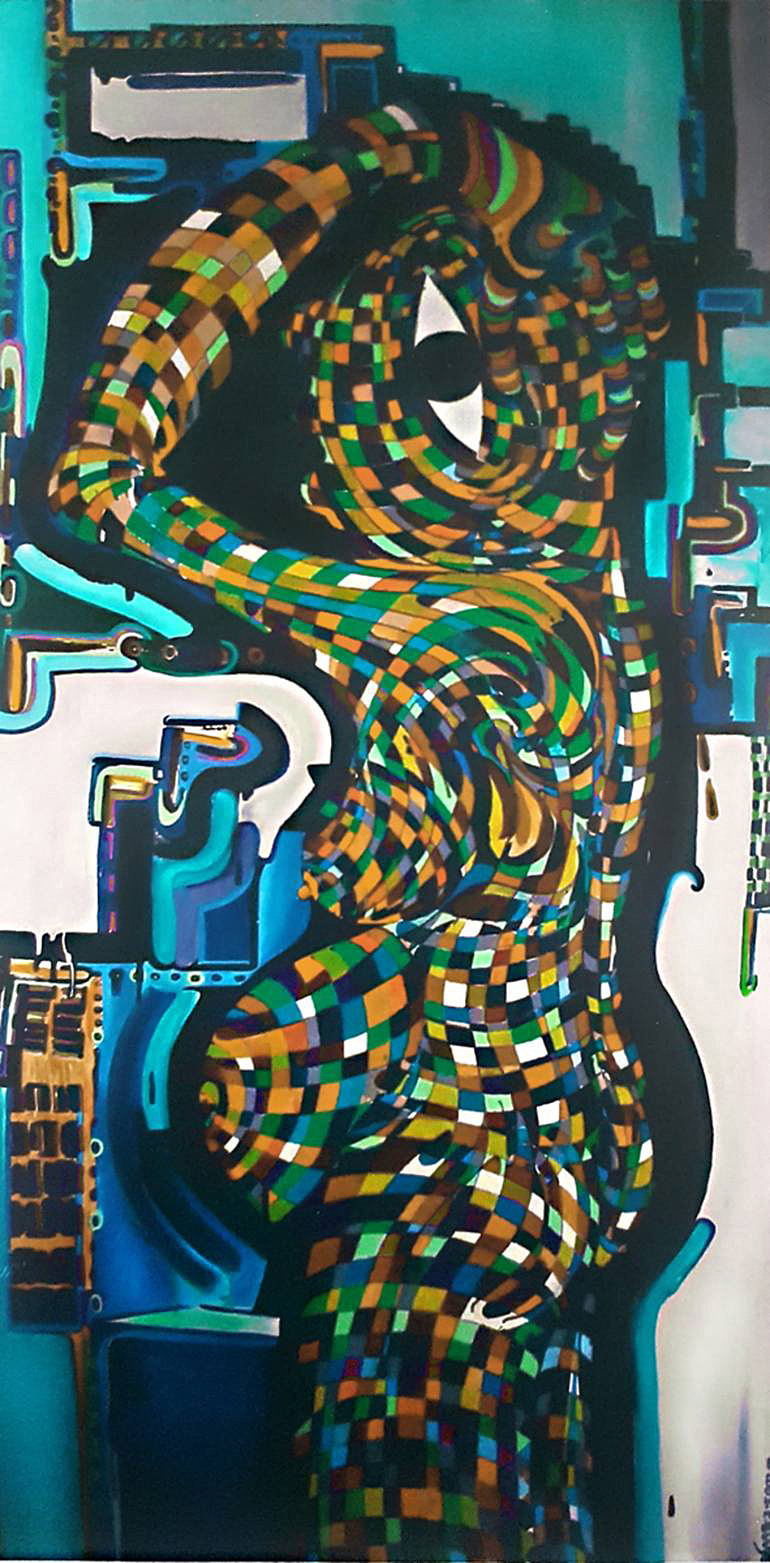
In Woman - After Silence (2009), the hands against the face and the long descent of the legs hold the composition together. The surrounding patterned surfaces echo the body’s curvature. The effect is enclosing: figure and environment appear to participate in the same continuous system. The pose and title allow a reading of withdrawal, although they do not settle the figure’s emotional state.
These paintings also expose a difficulty within the method. An insistent pattern can give every part of a picture equal emphasis. The most consequential decisions are therefore the interruptions: a gaze, a hand, a grey body, a change of scale. They give the viewer somewhere to pause.
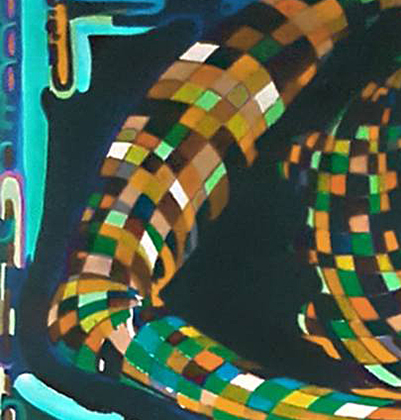
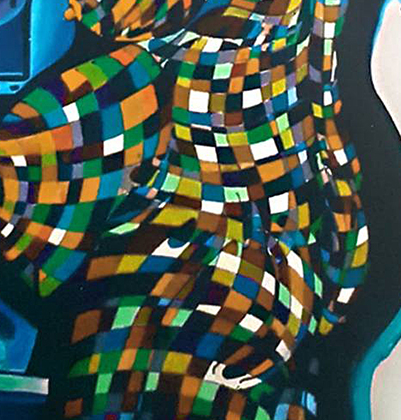
The Oedipus Complex
The eye anchors a composition in which curved bands move between recognisable anatomy and abstract form.
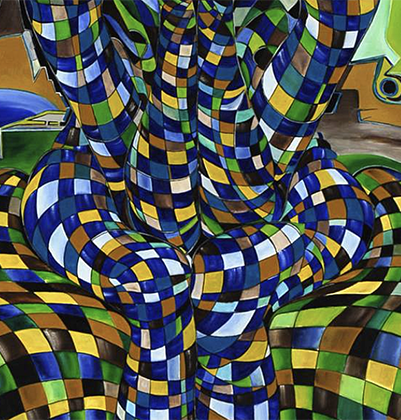
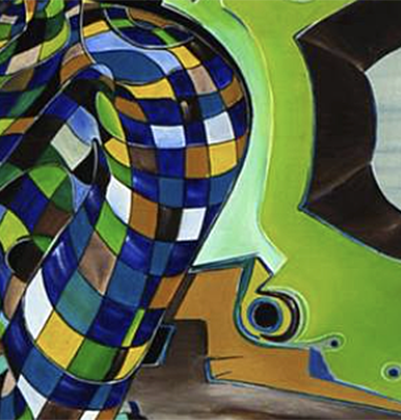
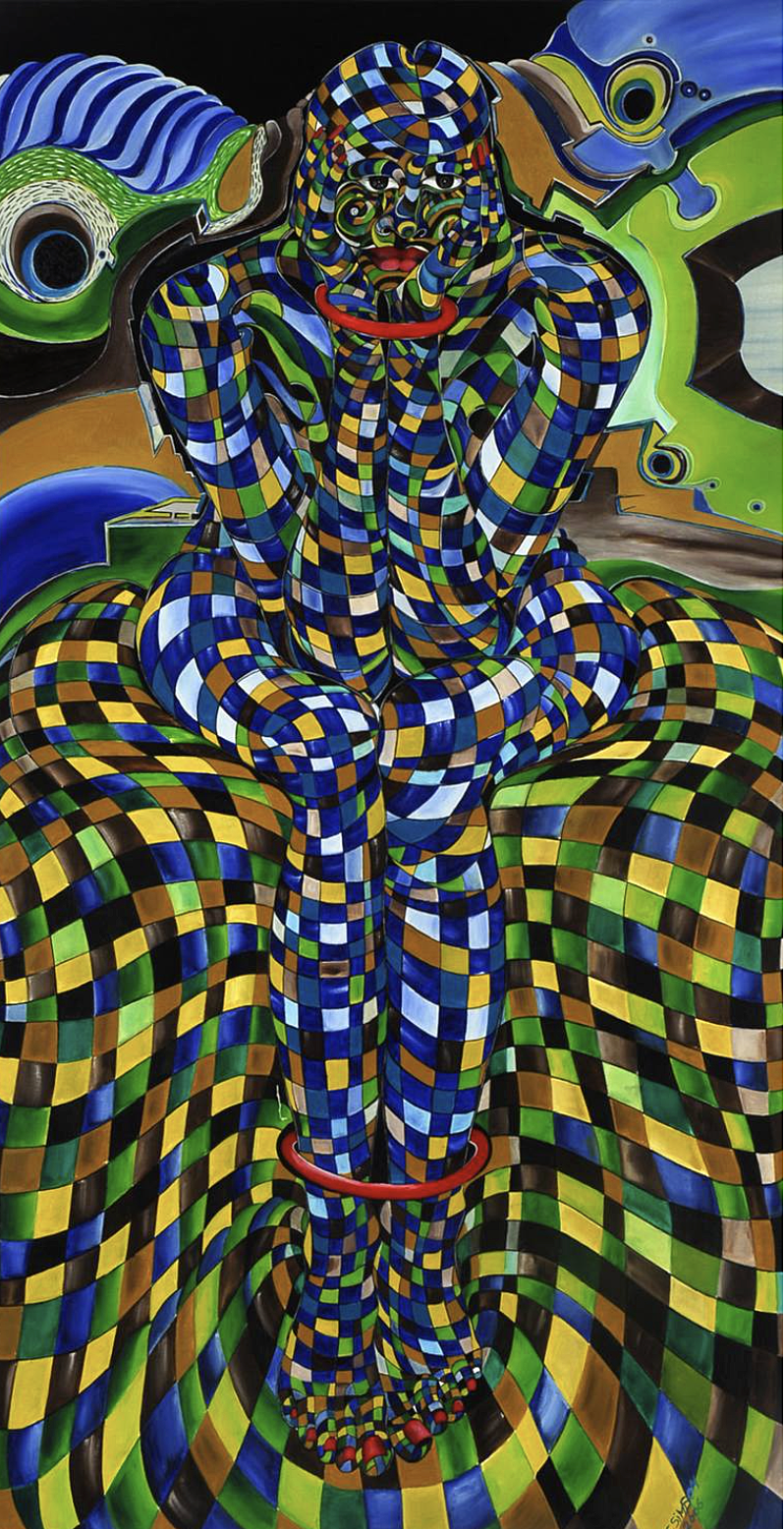
Woman - After Silence
The repeated grid connects the seated figure with the surrounding surfaces. View the complete work to read the enclosing composition.
The Colour of Pain, catalogued as acrylic on paper and dated 2008, extends the emotional context of this work. Its title prevents bright colour from being treated as an uncomplicated sign of pleasure. The Digital Form belongs in the discussion of how division changes the reading of a figure. Its title alone does not establish a digital production technique.
Resemblance deserves close looking
The correspondences with the selected Irzyk paintings concern a combination of devices: multicoloured cells arranged in curved rows, strong changes in their apparent scale, and a surface that seems to bend into depth. Describing this only as a shared use of squares would miss the more specific visual relationship.
Irzyk’s Cathedral and Tools and Ways are both catalogued as oil paintings from 2022. Their inclusion here gives the comparison a dated reference beyond the more recent exhibition material. The images should be read as complete compositions, with their titles and sources retained.
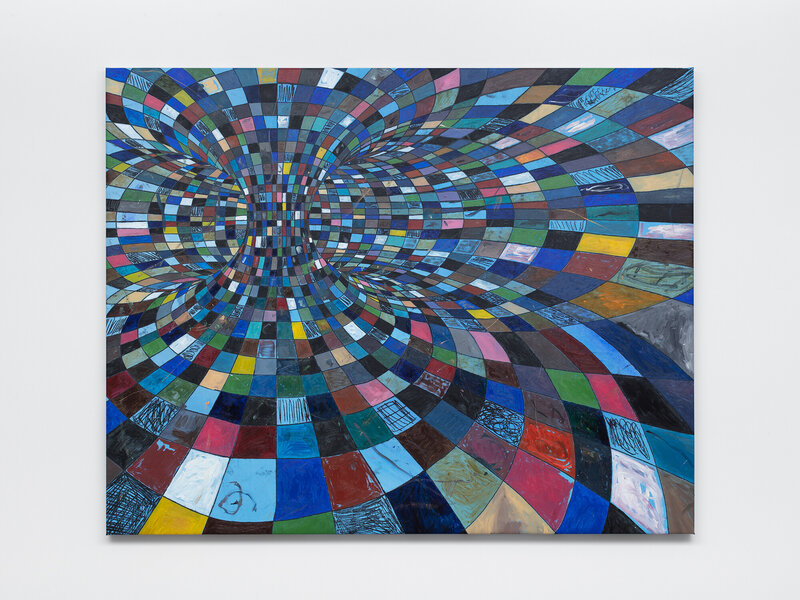
Cathedral
Oil on canvas · Image source: PM/AM via Artsy.View catalogue entry
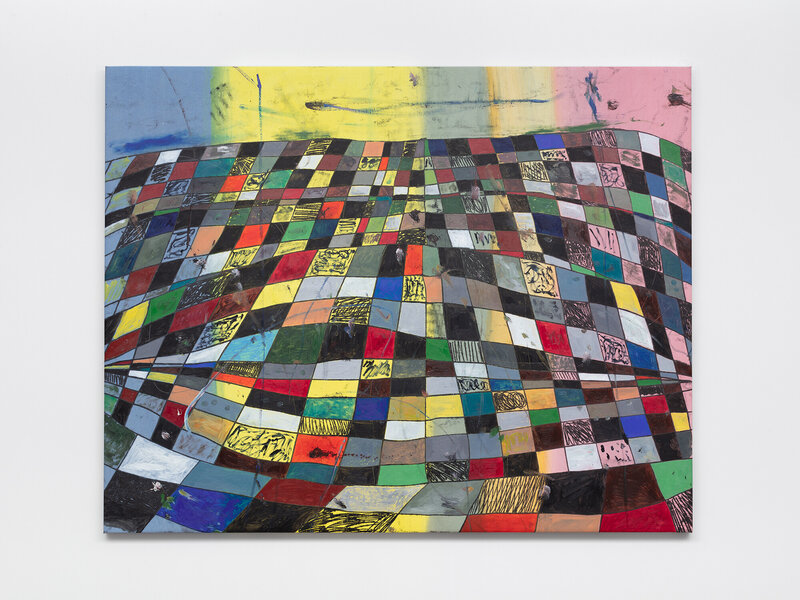
Tools and Ways
Oil on canvas · Image source: PM/AM via Artsy.View catalogue entry
In Cathedral, the grid contracts towards a recess to the left of centre. The widening cells at the edges make that contraction more forceful. Compared with In to the Soul, the absence of explicit human figures changes the source of scale: the coloured surface must establish its own depth. The resemblance lies in the curved cellular construction; the bodily interruption that organises my painting is absent.
Tools and Ways sets up a different movement. Broad gridded surfaces rise and dip across the canvas, beneath a relatively open upper strip. Individual cells contain uneven marks and variations of paint. In In to the Soul, the repeated lines inside many cells reinforce their enclosing shapes. These are visible differences in how a divided surface is animated, although photographs cannot resolve every material detail.
The comparison becomes less useful if it divides two entire practices into “figurative” and “abstract”. My own grid can move beyond recognisable anatomy. The relevant question concerns each painting: what makes its space cohere, and what gives that space a particular character? In the works discussed here, bodily gesture, optical recession and the activity inside individual cells carry different weights.
The resemblance is substantial enough to examine. Its cause remains a separate question. The dates establish an earlier place for the selected works in my practice; the material assembled here does not establish that Irzyk encountered or derived his paintings from them.
Keeping the record specific
The two Time Machine paintings date to 2005, seventeen calendar years before the selected Irzyk paintings of 2022. The chronology gives this comparison a historical basis. It records the dates of the works discussed here, rather than claiming an origin for every use of the curved grid.
The dates for both Time Machine paintings, Couple and Woman - After Silence are supplied by the artist. Saatchi Art catalogue entries record 2006 for The Oedipus Complex and 2008 for The Colour of Pain. Creation dates are distinct from image-upload and publication dates.
Irzyk’s Club Hell exhibition at My Pet Ram ran from 20 January to 19 February 2023. Its page dates Skyhook, Bar, Lot and Spanner to 2022, and House of Problems to 2023. KDR’s Total Modeling presentation also dates to 2023. Those records belong alongside the later exhibition, rather than being displaced by it.
For my paintings, the enduring question is what happens to a person when the same pattern describes both the body and the world around it. The faces in Couple, the raised arms in Becoming Digital and the seated posture in Woman - After Silence give different answers. Their gestures make the grid particular. Preserving the complete works, their details and their dates lets that distinction remain visible.
Explore the paintings
View more paintings, or read about commissioning a work for a personal, family or institutional project.