Art Criticism · Visual Culture · Creative Provenance
Explore Carlos Simpson’s research, publications, creative practice and human-development work.
Creativity has always involved transformation. Artists observe, interpret, deconstruct, reconstruct and reimagine the world around them. Yet digital technologies have introduced new possibilities — and new questions — about originality, artistic identity and authorship.
Consider two bodies of visual work: paintings by Carlos Simpson developed between 2005 and 2009, and a later digital treatment of Auguste Rodin’s The Thinker published by GDJ on Pixabay in 2021 and subsequently used on the cover of Routledge’s 2024 second edition of The New Critical Thinking: An Empirically Informed Introduction.
The comparison raises a question worth examining:
This is not simply a discussion about colour or geometric shapes. It concerns the relationship between artistic intention, visual structure, technological intervention and the historical development of creative ideas.
The Development of a Visual Language: Carlos Simpson, 2005–2009
The strongest argument for Carlos Simpson’s visual language is not that another image made years later happens to resemble it. The stronger argument is that the language can be seen developing across his own work over time.
A style is not established simply because an artist uses bright colour, geometric shapes or the human figure. Those devices belong to no one. What becomes more significant is the sustained combination of decisions: how colour is organised, how form is fragmented, how the figure relates to its surrounding space, how a visual system repeats from one work to another and how that system changes without losing its identity.
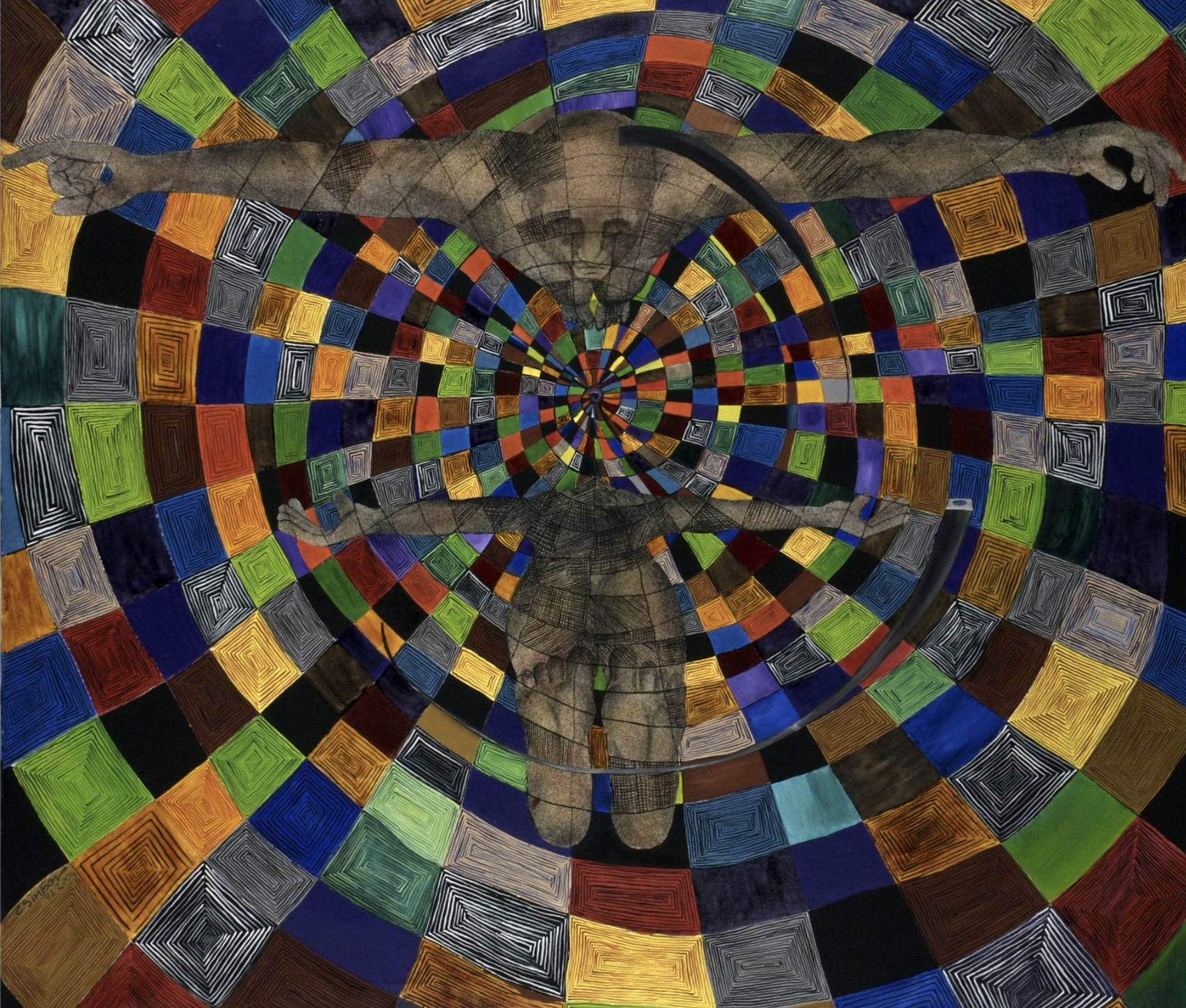
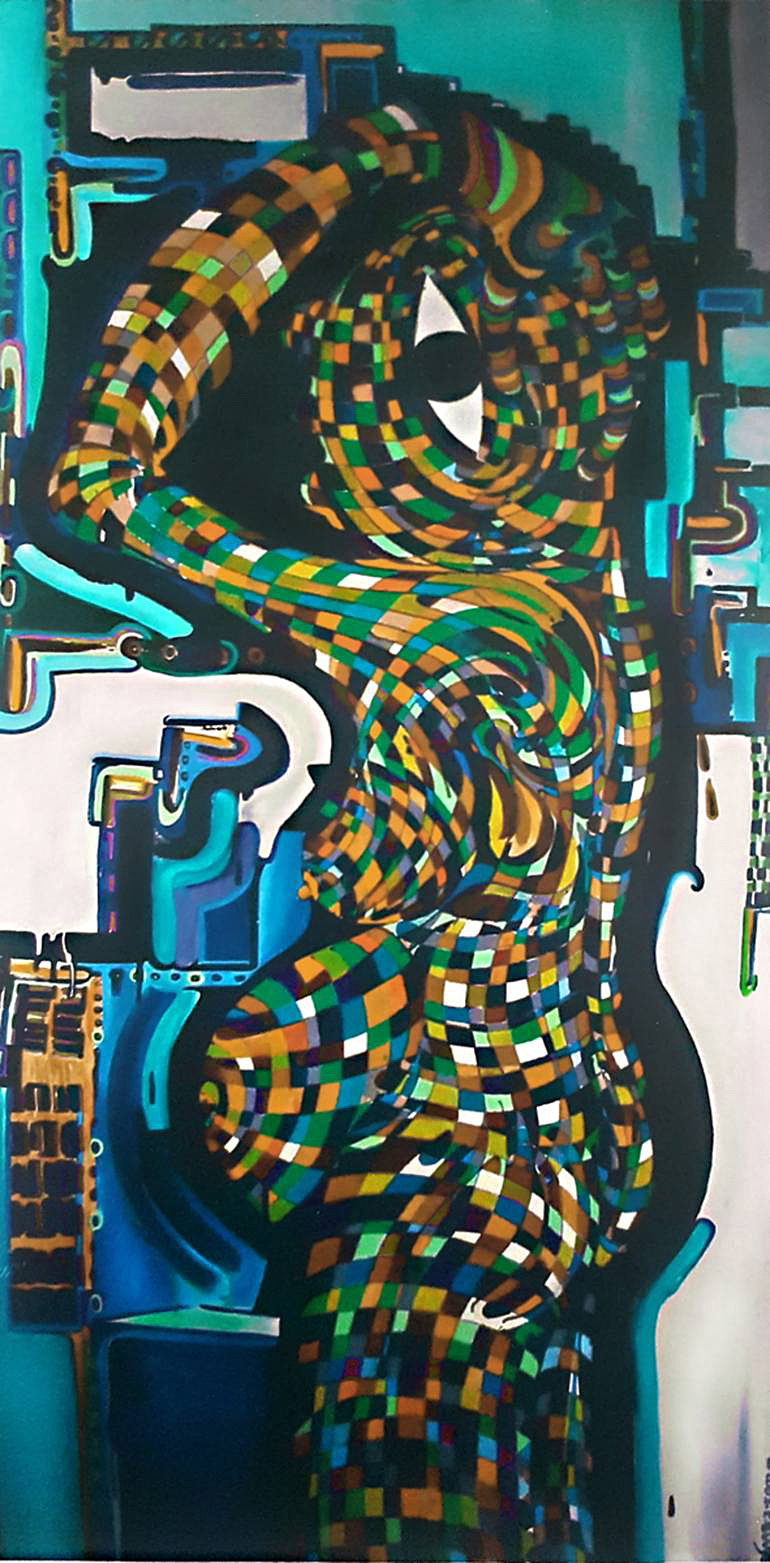
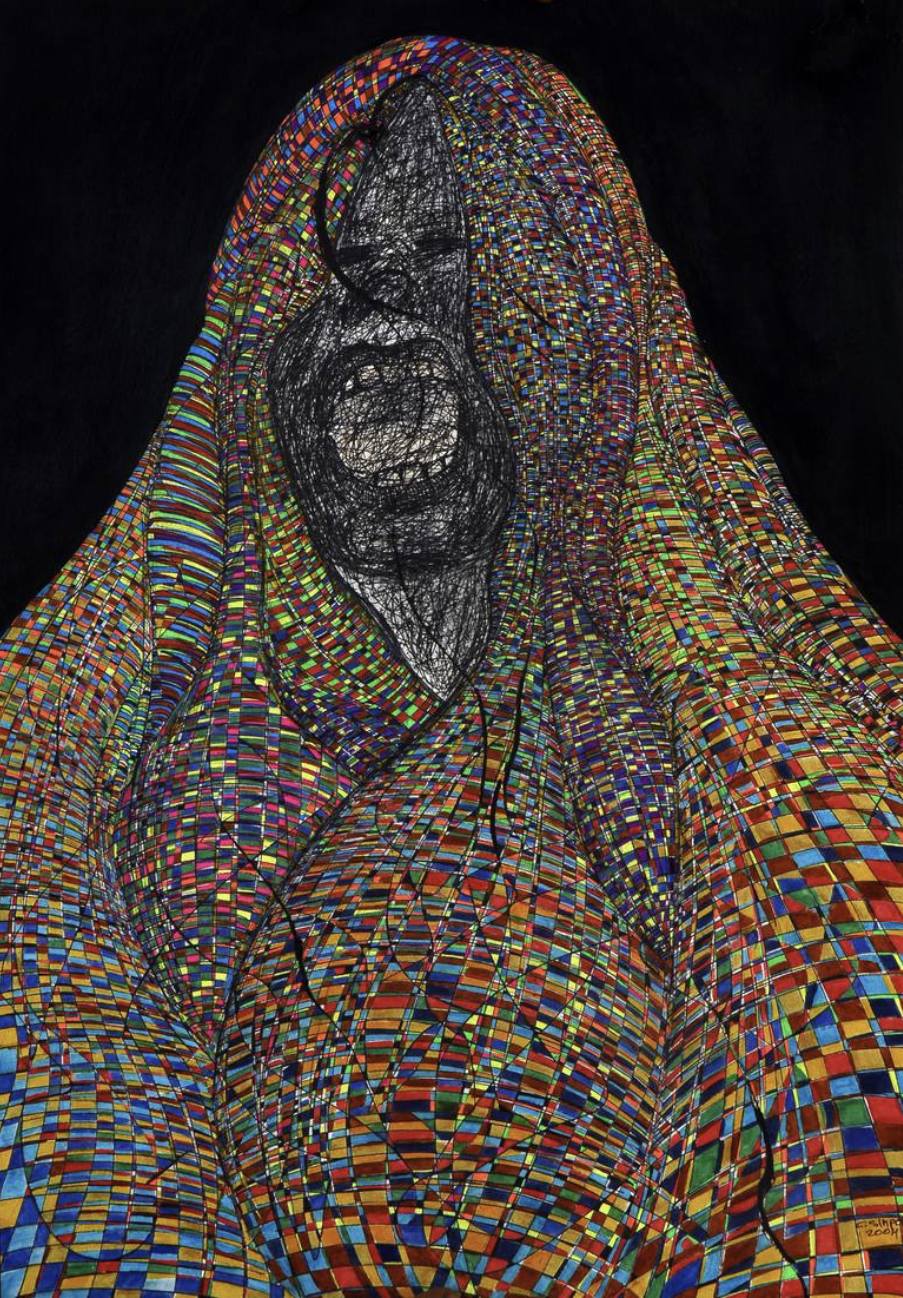
View Saatchi Art record →
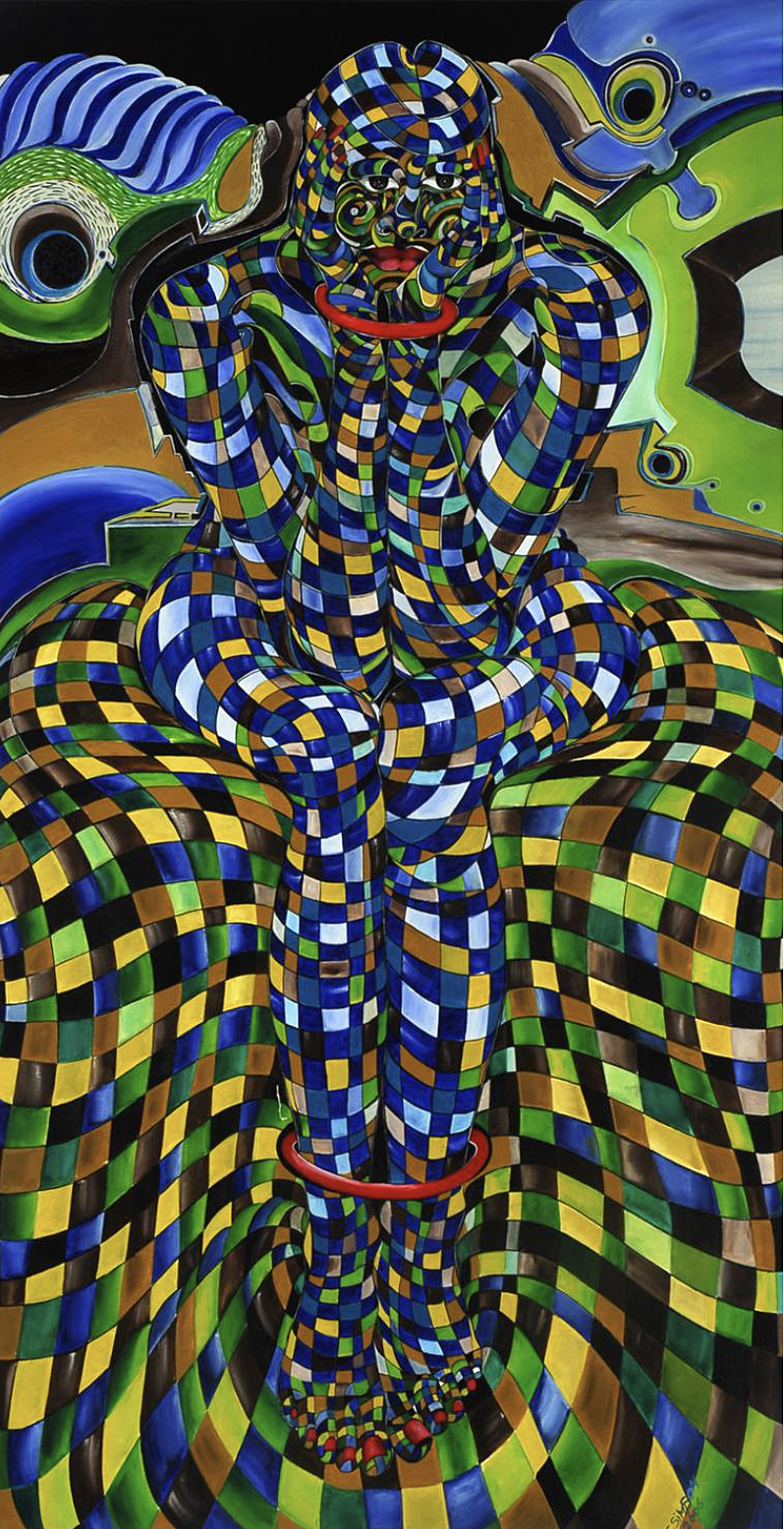
These works demonstrate an approach in which geometric pattern does not simply decorate the human figure. It interacts with anatomy, follows its contours and transforms the viewer’s perception of the body.
In some compositions, the pattern extends beyond the figure, connecting the human form with its surrounding environment.
This creates an identifiable visual relationship between colour, geometry, human anatomy and spatial perception.
The dates are significant because they establish that these explorations were present in Simpson’s artistic practice well before the digital representations of The Thinker discussed later in this article.
Colour as Structure, Not Decoration
Across Simpson’s works from 2005 to 2009, the body is not simply painted and then decorated with colour. The body is reconstructed through colour.
In Time Machine: Becoming Digital, the grid has an almost technological urgency. The figure appears caught between the biological and the computational. Small chromatic units accumulate across the body, breaking the solidity of anatomy into a field of visual information while the human form remains legible.
Simpson holds the body at the threshold between recognition and fragmentation. The geometry therefore becomes more than surface treatment. It becomes conceptual structure.
The Body as a Constructed Field
By The Oedipus Complex, the relationship between anatomy and pattern becomes more psychologically charged. The geometric units adhere to the figure, but also compete with it. Colour fragments the body while simultaneously holding it together.
The viewer experiences a double recognition: the person remains visible, but so does the system through which that person has been visually constructed.
This is where Simpson’s colour becomes more interesting than chromatic exuberance alone. Reds, blues, yellows and greens collide in small repeated units. The eye moves continually between individual fragments and the larger human form.
Colour becomes an engine of perception.
Emotion Within the Grid
In The Colour of Pain, the language acquires another emotional temperature. The title itself resists any reading of colour as merely decorative pleasure. Colour is attached to pain, interior experience and embodiment.
The visual fragmentation becomes psychologically suggestive. The figure is simultaneously whole and divided.
This is one of the more compelling aspects of Simpson’s practice during this period. The grid does not operate as a neutral design device. It can suggest digital organisation, connectivity and transformation, but also division, pressure, vulnerability and psychic disturbance.
Figure, Environment and Identity
By Woman – After Silence, the relationship between figure and environment becomes more expansive. The pattern no longer appears confined to the body. Figure and surrounding field begin to communicate through a shared chromatic architecture.
This shifts the work away from the simple idea of a patterned human figure. The deeper proposition is relational: the person exists within systems.
The body is individual, yet connected to structures around it. Interior and exterior, identity and system begin to occupy the same visual field.
Longevity and Authenticity
Seen together, these works establish something an isolated painting cannot: continuity.
Between 2005 and 2009, Simpson returns repeatedly to the problem of constructing human form through multicoloured geometric fragmentation. He does not produce the same painting four times. The visual grammar persists while its psychological and conceptual functions evolve.
That is how an artistic language becomes recognisable.
The most persuasive evidence of authenticity in an artist’s practice is rarely a declaration of originality. It is duration: the accumulation of works, dates, files, experiments, variations and repeated returns to unresolved questions.
Authenticity develops through repetition with difference.
The Second Visual Reference: GDJ and The Thinker 3D
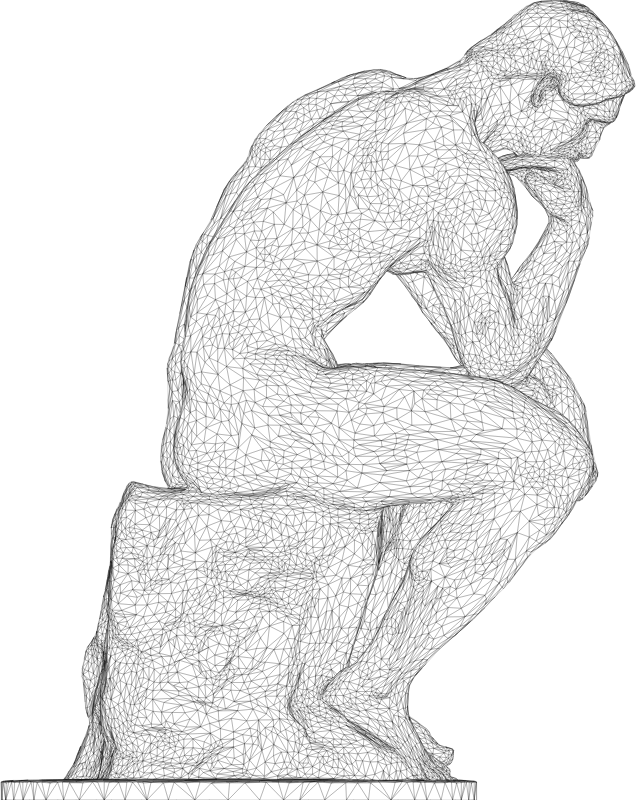
GDJ’s The Thinker 3D was uploaded to Openclipart on 10 May 2021.
The representation translates Rodin’s familiar sculpture into a digital geometric structure.
Its low-poly construction provides an important intermediate stage in the visual chronology because the geometry of the body is already present before the later multicoloured treatment.
The underlying digital model and its subsequent chromatic treatment should therefore be understood as distinct stages within the same documented sequence.
A SuperColoring record also identifies GDJ on Openclipart as the source of its The Thinker 3D Wireframe representation.
The Multicoloured Transformation: 23 May 2021

The multicoloured treatment can now be traced more precisely. Pixabay identifies GDJ as the contributor of a colourful, prismatic and geometric vector representation of The Thinker, published on 23 May 2021.
This record appears thirteen days after GDJ’s The Thinker 3D was uploaded to Openclipart on 10 May 2021.
The two records therefore establish a documented sequence from the geometric 3D representation to the multicoloured version.
What makes the second image particularly interesting in relation to Simpson’s earlier paintings is its chromatic treatment.
The human figure is covered with numerous small colour elements, creating a fragmented, mosaic-like surface. The colours follow the contours of the body, creating a visual relationship between geometric division and human anatomy.
This is where comparison becomes legitimate.
The resemblance is not simply the presence of bright colours. It lies in the transformation of a recognisable human body into a field of repeated chromatic geometric units whose structure follows anatomy.
The available public records attribute the 2021 multicoloured image to GDJ.
What those records do not establish is whether the treatment developed independently or whether any earlier artistic practice influenced its development.
Chronology can establish precedence. It cannot, by itself, establish influence.
From Digital Asset to Published Book Cover

Routledge subsequently used the multicoloured Thinker image on the second edition of The New Critical Thinking: An Empirically Informed Introduction by Jack Lyons and Barry Ward.
The publisher credits the cover image as The Thinker/GDJ, Pixabay.
This provides another important distinction. The book is not the origin of the image. It is a later institutional use of a visual asset already publicly associated with GDJ.
The Chronology: Why Dates Matter
The historical sequence provides a basis for examining the relationship between the works without confusing chronology with proof of influence.
| Year / date | Documented creative record |
|---|---|
| 2005 | Carlos Simpson — Time Machine: Becoming Digital |
| 2006 | Carlos Simpson — The Oedipus Complex |
| 2008 | Carlos Simpson — The Colour of Pain |
| 2009 | Carlos Simpson — Woman – After Silence (artist chronology) |
| 10 May 2021 | GDJ — The Thinker 3D, Openclipart |
| 23 May 2021 | GDJ — multicoloured/prismatic The Thinker, Pixabay |
| 2024 | Routledge second edition of The New Critical Thinking using a cover credited as The Thinker/GDJ, Pixabay |
Carlos Simpson’s paintings demonstrate that the exploration of multicoloured geometric structures applied to human anatomy was already present in his work between 2005 and 2009.
The GDJ records establish a later digital sequence in May 2021, followed by the Routledge book-cover use in 2024.
This chronology establishes precedence within Simpson’s own artistic practice. It does not establish that GDJ encountered, copied or was influenced by Simpson’s work.
A Comparative Examination of Visual Language
Geometry and Anatomy
In Simpson’s paintings, geometric divisions follow the contours of the human figure. Pattern becomes part of the visual construction of the body rather than an ornamental layer applied afterwards.
The multicoloured Thinker also uses repeated colour units to articulate anatomical volume.
Colour as a Structural Element
In both bodies of work, colour is not simply applied to an otherwise neutral image. It becomes essential to how form is perceived.
Simpson’s painted grids generate continuity, interruption, movement and psychological pressure. GDJ’s digital treatment produces a faceted chromatic surface across an existing sculptural form.
Fragmentation and Repetition
Both invite examination of how repeated visual units can construct a recognisable human figure while simultaneously fragmenting it.
Figure and Environment
Simpson’s work often extends geometric structure beyond the body, connecting the figure to its surrounding space.
GDJ’s Thinker remains compositionally closer to the isolated sculptural figure. The visual relationship is therefore meaningful without being identical.
Why the Comparison Is Legitimate
The resemblance is not simply that both artists use bright colour.
It lies in a combination of formal characteristics:
- A recognisable human figure.
- A body transformed through repeated multicoloured geometric units.
- Colour structures that follow anatomical contours.
- An oscillation between recognisable human form and fragmented surface.
- Colour operating as part of form rather than as decoration alone.
These are meaningful formal correspondences.
They deserve examination. They do not, on their own, establish copying, influence or a causal relationship between the artists.
Is Digital Transformation the Same as Original Creativity?
Digital tools have dramatically changed the possibilities available to artists.
An existing three-dimensional model can be recoloured, textured, fragmented, manipulated and transformed into something visually different.
But the existence of a new image does not automatically answer the question of originality.
We should distinguish between:
- The creation of an original visual concept.
- The development of an identifiable artistic language.
- The transformation of an existing visual structure.
- The application of visual characteristics already established elsewhere.
- The technical production of a new image.
These are different creative contributions.
An artist can use an existing subject without copying another artist. Equally, a digital transformation can introduce new technical features while raising legitimate questions about its relationship to visual languages that existed earlier.
This distinction becomes increasingly important in an age of generative AI, digital image manipulation and automated creative tools.
It is also important not to retroactively classify the 2021 GDJ image as AI-generated without evidence. The documented comparison here is between an earlier painted visual language and a later digital transformation.
The Wider Philosophical Question
Perhaps originality should not be understood as creating something from absolutely nothing.
Human creativity is cumulative. Artists learn from previous generations, reinterpret cultural references and develop new possibilities from existing ideas.
Recognising the cumulative nature of creativity should not, however, mean overlooking the historical development of individual artistic practices.
An artist’s creative identity can emerge through years of experimentation, repetition, refinement and conceptual development.
That development deserves documentation.
The question is not whether two artists are permitted to use geometric patterns, colourful compositions or representations of the human body.
They are.
The more interesting question is whether a particular combination, organisation and application of visual characteristics becomes recognisable as an artist’s visual language — and how that contribution should be understood when comparable visual structures later appear elsewhere.
A visual language gains credibility through continuity: repeated formal decisions, developed across time, while continuing to generate new meanings.
Three Questions for the Creative Community
- If an artist develops a distinctive visual language years before a comparable digital transformation appears, how should that chronology inform our understanding of originality?
- When an existing digital model is transformed using a visual approach that resembles an established artistic practice, where should we draw the distinction between independent convergence, inspiration, reinterpretation and imitation?
- In the age of artificial intelligence and digital reproduction, should significant transformations carry clearer information about their source material, modifications and creative contributors?
Conclusion: Creativity Deserves a History
The comparison between Carlos Simpson’s paintings from 2005–2009 and the later digital representations of The Thinker provides an opportunity to examine creativity beyond the immediate appearance of an image.
It invites us to consider the relationship between artistic development, chronology, technological transformation and authorship.
We should not confuse resemblance with proof of copying. Nor should meaningful visual similarities be dismissed simply because their origins are difficult to establish.
Carlos Simpson’s documented use of multicoloured geometric structures across human anatomy predates GDJ’s 2021 Thinker treatment by more than a decade.
The chronology establishes precedence within Simpson’s own practice. It does not establish that GDJ encountered, copied or was influenced by that work.
That uncertainty does not make the comparison irrelevant. It defines the limits within which responsible criticism should operate.
Creative freedom, artistic recognition and responsible attribution should coexist.
The later comparison may sharpen our attention, but Simpson’s paintings do not depend upon what happened in 2021 for their significance.
Across the earlier works, one persistent question survives: whether the human being remains a coherent individual or is continually being constructed through larger technological, psychological, cultural and social systems.
That question was already present in Simpson’s work in the middle of the 2000s.
Twenty years later, it has become harder to avoid.
Selected Visual Records and Sources
- Carlos Simpson — Time Machine: Becoming Digital (2005), artist archive.
- Carlos Simpson — The Oedipus Complex (2006), artist archive.
- Carlos Simpson — The Colour of Pain (2008). Saatchi Art catalogue record .
- Carlos Simpson — Woman – After Silence (2009 artist chronology), artist archive.
- GDJ — The Thinker 3D, Openclipart, 10 May 2021. View record .
- GDJ — multicoloured/prismatic The Thinker, Pixabay, 23 May 2021. View record .
- Jack Lyons and Barry Ward — The New Critical Thinking: An Empirically Informed Introduction, second edition, Routledge, 2024. View publisher record .